


Informational guide · Updated October 2026
Weak Urine Stream in Men: Causes, Warning Signs and Treatment Options
A weak urine stream in men is a slow, thin or stop-and-start flow of urine. One common cause is an enlarged prostate, known as BPH, which can press on the urethra. Prostatitis, a narrowed urethra, some medicines and bladder problems can also play a part. See a doctor soon, and get care right away if you cannot urinate.
- What Is a Weak Urine Stream?
- Causes of a Weak Urine Stream in Men
- Benign Prostatic Hyperplasia (BPH): A Common Cause
- Prostatitis, Pelvic Pain and Lower Back Pain
- Other Causes: Urethral Stricture, Medicines and Bladder Problems
- Prostate Cancer and the PSA Test
- Blood in the Urine and Other Warning Signs
- Urology Tests for Urine Flow Rate and Bladder Emptying
- Treatment Options to Relax the Prostate and Improve Flow
- Daily Habits That May Ease Symptoms
- Myths About Prostate Size and Urine Flow
- Frequently Asked Questions
- References
What Is a Weak Urine Stream?
A weak urine stream means your urine flows more slowly or with less force than it used to. You may have trouble starting or maintaining the flow, or it may dribble at the end.[1] Weak urine flow is common, and it has several possible causes.
Some men experience urinary changes slowly. You may wait longer at the toilet, or feel that your bladder is not empty when you finish.
Common signs to watch for
- Trouble starting a urine stream or emptying your bladder
- A weak or interrupted stream, or dribbling at the end of urination
- Waking up at night to urinate, called nocturia
- A sudden urge to go, or frequent urination
- Pain during urination
These are the symptoms NIDDK lists for BPH. Difficulty urinating can come from other causes too.[1]
Doctors call difficulty starting urination urinary hesitancy. A weak stream and a slow stream describe the same kind of change in how fast urine leaves the body. Each can point to a blockage, or to a bladder muscle that cannot push with enough force.[1] Only a health care professional can tell you which one is behind your symptoms.
Causes of a Weak Urine Stream in Men
Several problems can lead to a weak stream. Most work in one of two ways. Something narrows the urethra, the tube that carries urine out of the body. Or the bladder muscle cannot push with enough force, leading to a weak urine stream.[1] The sections below cover the potential causes, starting with the most common one.
Benign Prostatic Hyperplasia (BPH): A Common Cause
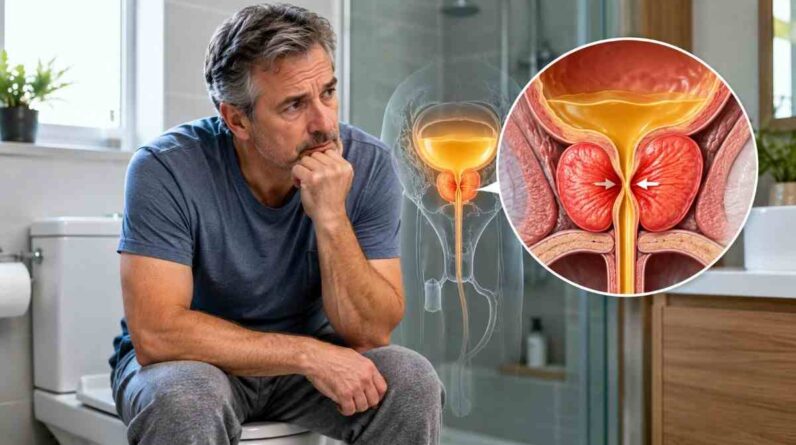
Benign prostatic hyperplasia, or BPH, is a common cause of a weak urine stream in men. In BPH, the prostate gland grows larger than normal, but the growth is not cancer.[1] The prostate sits below the bladder and wraps around the urethra.
When the prostate enlarges, the gland presses on the urethra and pinches it. An enlarged prostate gland can compress the urethra much like a hand squeezing a garden hose.
Sequence as described by NIDDK.[1]
The bladder muscle then has to work harder. Over time it may weaken and leave some urine behind. That is called urinary retention, or incomplete bladder emptying.[1] NIDDK notes that retention affects both men and women, but it happens more often in men, especially as they get older.[3]
BPH is common in older men. NIDDK estimates it affects 5% to 6% of men ages 40 to 64 and 29% to 33% of men ages 65 and older.[1] Scientists are not sure why it happens. They think aging and changing hormone levels play a part.[1]
Source: NIDDK estimates.[1, 4] Compare bars within a group, not across groups. Our prostatitis figure comes from an older NIDDK page.
Size does not tell the whole story. A large prostate may cause few symptoms, while a slightly enlarged one can cause more.[1] That is why a doctor looks at your symptoms and not just the size of the gland.
You are more likely to develop BPH if you are 40 or older, have a family history of BPH, or are not physically active. Type 2 diabetes, heart and blood vessel disease, obesity, chronic kidney disease and erectile dysfunction also increase your risk.[1] The American Urological Association calls BPH a leading cause of urinary symptoms as men age.[5]
Prostatitis, Pelvic Pain and Lower Back Pain
Prostatitis is swelling or inflammation of the prostate. It is the most common prostate problem in men younger than 50.[6] Some forms come from bacteria, and others do not.[4]
A weak or interrupted stream is one possible sign. Other signs include pelvic pain, lower back pain, pain in the penis or scrotum, and pain with ejaculation.[4] Seek medical care right away for sudden, severe symptoms with fever and chills. Acute bacterial prostatitis is treated with antibiotics.[4] Prostatitis differs from BPH because it is inflammation, often with pain, while BPH is growth of the gland.
Other Causes: Urethral Stricture, Medicines and Bladder Problems
Urethral stricture
A urethral stricture is scar tissue that narrows the urethra. Cleveland Clinic lists a weak or slow stream as the most common sign.[7] Long-term inflammation or an injury often causes the scarring. Strictures can affect people of all ages, but they are more common in men than in women.[8]
Medicines
Some medicines can make BPH symptoms worse. NIDDK lists cold and cough medicines such as decongestants or antihistamines, tranquilizers, antidepressants and diuretics.[1] Tell your provider about every medicine you take. Do not stop a prescribed medicine on your own.
Bladder problems and infections
Other causes include bladder problems and urinary tract infections, which can look like BPH. Prostatitis and prostate cancer can look like it too.[1] Tests help sort out which one it is.
Causes at a glance
| Cause | How it can affect flow | Other clues | Usual next step |
|---|---|---|---|
| BPH | Enlarged prostate pinches the urethra | Nighttime urination, urgency, dribbling | Exam, urine test, PSA test talk[1] |
| Prostatitis | Swelling near the urethra | Pelvic or lower back pain, pain with ejaculation | Urine test; antibiotics for bacterial types[4] |
| Urethral stricture | Scar tissue narrows the tube | Discomfort when urinating, belly pain, infections | Flow tests, imaging, stretching or a small cut[7, 8] |
| Medicines | Some drugs worsen BPH symptoms | A new cold remedy, antidepressant or diuretic | Review every medicine with your provider[1] |
| Bladder problems or infection | Weak bladder muscle or infection | Burning, urgency, fever | Urinalysis and other tests[1] |
This table combines points from the cited NIDDK and Cleveland Clinic pages. It is a summary, not new research.
Prostate Cancer and the PSA Test
BPH is not cancer.[1] Prostate cancer can cause urinary symptoms like these, though, and so can prostatitis.[1] That is why a doctor may order a PSA test. It measures a protein made by prostate cells. A high PSA level does not always mean prostate cancer.[9]
Blood in the Urine and Other Warning Signs
A few signs need quicker action if you are experiencing a weak urine stream.
Tell a health care professional right away if you:
- cannot urinate at all
- have painful, frequent and urgent needs to urinate, along with fever and chills
- see blood in your urine
- feel great discomfort or pain in your lower belly or urinary tract
A sudden, complete inability to urinate is called acute urinary retention. It needs care right away.[3] Blood in the urine can come from BPH, an infection or other problems, so it always deserves a check.[1]
Don’t ignore a stream that stays weak, keeps getting worse or comes with pain. Without treatment, BPH can lead to urinary tract infections, bladder stones and kidney disease.[1] Consult your doctor if you are not sure whether your symptoms need a visit.
Book a visit with your doctor.
See a provider soon and ask about prostatitis or infection.
Call a health care professional right away.
Get medical care right away.
Urology Tests for Urine Flow Rate and Bladder Emptying
Your family doctor often starts the check-up. You may then see a urologist, a doctor who treats the urinary tract and the male reproductive system.[4] In a urology visit, the doctor asks about your specific symptoms and guides the tests that follow. Expect questions about your medicines, how much you drink and your family history.[1]
Tests that you may hear about include the following.[1, 4]
- A physical exam, which may include a digital rectal exam to feel the prostate
- Urinalysis, a test on a urine sample
- A PSA blood test
- Uroflowmetry, which measures how fast the bladder releases urine
- A post-void residual check, which shows how much urine stays after bladder emptying
- Cystoscopy, a thin scope used to look for narrowing, blockage or stones
- A transrectal ultrasound, which shows the size of the prostate
How to read your flow numbers
Uroflowmetry tracks your urine flow rate. Its top number is called Qmax, your peak urinary flow speed in milliliters per second (mL/s). Clinic guides use set ranges to read it.[2] Flow also depends on how much urine you pass, so one number never tells the whole story.[10]
Ranges from a clinic guide, which is a secondary source.[2] A review in a urology journal also treats flow below 10 mL/s as a sign of obstruction.[10]
Treatment Options to Relax the Prostate and Improve Flow
Treatment options are based on your specific symptoms, the cause and how much the problem bothers you. The aim is to improve quality of life, not just to change a number on a test.[1] A 2021 American Urological Association guideline says symptoms in aging men tend to progress, and care should fit the person.[11]
| Option | What it involves | Good to know |
|---|---|---|
| Watchful waiting | No drugs. Yearly checkups and habit changes. | May suit a slightly enlarged prostate when symptoms do not affect quality of life[1] |
| Medicines | Alpha blockers, 5-alpha reductase inhibitors, phosphodiesterase-5 inhibitors | Side effects are possible, so report them to your provider[1] |
| Minimally invasive procedures | Water vapor therapy or a prostatic urethral lift | They remove prostate tissue or widen the urethra[1] |
| Surgery | Removes part or all of the prostate | Complications can include sexual problems. About 10% of people may need more surgery within 20 years[1] |
Summary of NIDDK guidance for BPH, not a personal plan.
Medicines that treat urinary symptoms from BPH come in three groups. Alpha blockers help relax the prostate and bladder neck muscles, which makes it easier to urinate. The 5-alpha reductase inhibitors help stop prostate growth or shrink the prostate. Phosphodiesterase-5 inhibitors relax muscles around the bladder, bladder neck and prostate.
Research shows that an alpha blocker plus a 5-alpha reductase inhibitor may work better than one medicine alone.[1]
Other causes get other care. Bacterial prostatitis is treated with antibiotics, and the course can last from weeks to months.[4] A short urethral stricture may first be treated by stretching the urethra or with a small cut to open it.[7]
Daily Habits That May Ease Symptoms
Small habits will not fix a blockage, but they can ease some symptoms. NIDDK suggests these steps for men on watchful waiting.[1]
- Drink fewer liquids before you go out or go to bed.
- Limit alcohol and caffeine.
- Stay physically active.
- Make a habit of emptying the bladder completely. Go often instead of holding urine for long periods.
- Check your medicines with your provider, since some can worsen BPH symptoms.
Researchers have not found that diet or nutrition causes or prevents BPH, but changes in what you drink may lessen some symptoms.[1] If prostatitis causes pelvic pain, a urologist may suggest pelvic floor exercises, warm baths or physical therapy.[4]
What about herbs and supplements?
Many people ask about herbs for prostate and urinary health. The sources used for this guide do not test herbs or supplements, so we make no claim about them.
A doctor should find the cause first. Talk with your doctor before you start any product, and read our guide to herbal supplements and medication safety. For a closer look at one product, see our ProstaVive review.
Myths About Prostate Size and Urine Flow
Frequently Asked Questions
What causes a weak urine stream in men?
A common cause is an enlarged prostate, called BPH, which can press on the urethra and slow the flow. Prostatitis, a narrowed urethra, some medicines and bladder problems can also cause it.
Does a weak urine stream always mean BPH?
No. NIDDK says some urinary symptoms can come from bladder problems, urinary tract infections, prostatitis or prostate cancer instead of BPH. That is why a health care professional should check any change in your stream.
When should I see a doctor about a weak urine stream?
Book a visit if your stream stays weak, gets worse or comes with pain. Get care right away if you cannot urinate at all or see blood in your urine. The same goes for a fever and chills with painful, frequent and urgent urination.
How do doctors measure urine flow?
A test called uroflowmetry measures how fast the bladder releases urine, and a post-void residual check shows how much urine stays behind. Doctors read the results together with your age, your symptoms and the amount of urine you passed.
Can a weak urine stream lead to other problems?
It can. NIDDK says BPH can lead to urinary retention, urinary tract infections, bladder stones, blood in the urine and kidney disease. Early treatment can help reduce the effects on quality of life.
Don’t ignore a change in your stream. A doctor can sort out whether BPH, prostatitis, a stricture or a medicine is behind it, and the right treatment follows from the cause.
Conclusion
Many men face a weak urine stream, and BPH is a common cause. Prostatitis, a narrowed urethra and some medicines can also slow the flow. The cause decides the treatment, so watch for warning signs and bring your medicine list to your visit.
References
- National Institute of Diabetes and Digestive and Kidney Diseases (NIDDK). Enlarged Prostate (Benign Prostatic Hyperplasia). Last reviewed June 2024. https://www.niddk.nih.gov/health-information/urologic-diseases/prostate-problems/enlarged-prostate-benign-prostatic-hyperplasia
- Dr. Paulo. Uroflowmetry: What It Is, How It Works, and What This Test Is Used For. Clinic guide, a secondary source. https://drpaulo.com.br/en/uroflowmetry/
- NIDDK. Definition & Facts of Urinary Retention. https://www.niddk.nih.gov/health-information/urologic-diseases/urinary-retention/definition-facts
- NIDDK. Prostatitis: Inflammation of the Prostate. Last reviewed July 2014 (older page; NIDDK notes it is not updated regularly). https://www.niddk.nih.gov/health-information/urologic-diseases/prostate-problems/prostatitis-inflammation-prostate
- American Urological Association. News release on updated guidance for lower urinary tract symptoms attributed to BPH, August 2021 (organization news release). https://auanet.org/about-us/media-center/press-center/american-urological-association-announces-updates-to-clinical-guidance-for-management-of-lower-urinary-tract-symptoms-attributed-to-benign-prostatic-hyperplasia
- NIDDK. Prostate Problems. https://www.niddk.nih.gov/health-information/urologic-diseases/prostate-problems
- Cleveland Clinic. Urethral Stricture in Men. https://my.clevelandclinic.org/health/diseases/15537-urethral-stricture-in-men
- Kaiser Permanente. Learning About Urethral Stricture in Men. https://healthy.kaiserpermanente.org/health-wellness/health-encyclopedia/he.Learning-About-Urethral-Stricture-in-Men.acg6094
- NIDDK. Prostate Enlargement (Benign Prostatic Hyperplasia), earlier archived version, for the PSA statement. https://kidney.niddk.nih.gov/kudiseases/pubs/prostateenlargement
- Uroflowmetry review. Bangladesh Journal of Urology (secondary review article, abstract-level reading). https://banglajol.info/index.php/BJU/article/view/59453/41803
- Lerner LB, McVary KT, Barry MJ, et al. Management of Lower Urinary Tract Symptoms Attributed to Benign Prostatic Hyperplasia: AUA Guideline Part I. Journal of Urology, 2021 (abstract page on a university repository). https://scholars.mssm.edu/en/publications/management-of-lower-urinary-tract-symptoms-attributed-to-benign-p/
- MedlinePlus. Enlarged prostate. https://medlineplus.gov/ency/article/000381.htm

Written by cskoch, who researches medicinal plants and herbal wellness at Herbal Daily Care. This guide is research-based: we reviewed published trials, meta-analyses, and the manufacturer’s own sales page. We did not purchase or test the product, and we do not claim first-hand results.