

Quick Answer
Rosemary oil for hair growth works mainly by improving scalp circulation and possibly reducing the activity of an enzyme linked to pattern hair loss. One clinical trial found it performed about as well as minoxidil 2% after six months, with less scalp itching. To use it, dilute a few drops in a carrier oil, massage into the scalp, and leave it on for at least a few hours before washing.
Rosemary oil has gone from a niche aromatherapy ingredient to one of the most searched natural options for thinning hair, and unlike most trending hair remedies, it actually has a real clinical trial behind it.
This guide covers what the research says, how rosemary oil is thought to work on hair follicles, and exactly how to dilute and apply it safely. It’s written for anyone considering it as a natural addition to their hair routine, not as a replacement for a dermatologist’s advice on diagnosed hair loss.
For rosemary’s other health uses beyond hair, see our full guide to rosemary herb health benefits.
What Is Rosemary Oil for Hair, Exactly?
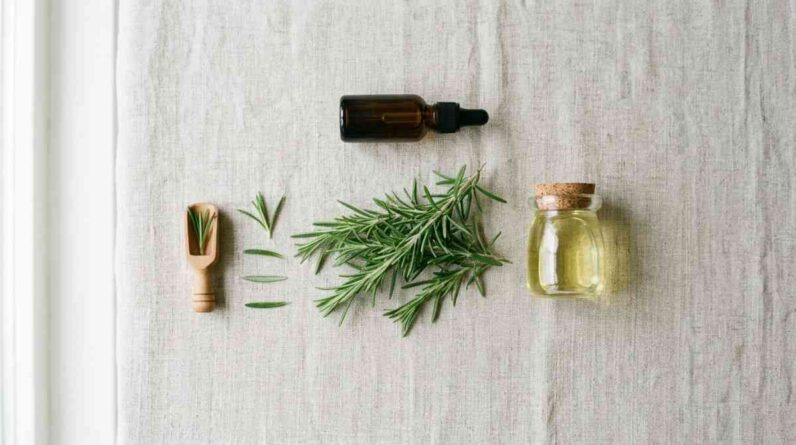
Rosemary oil for hair typically refers to rosemary essential oil, a concentrated extract steam-distilled from the leaves of Salvia rosmarinus, diluted into a carrier oil and applied to the scalp. It’s different from rosemary-infused hair products, which use a much lower concentration, and from rosemary water, which is an aqueous infusion rather than an oil-based one. This guide focuses specifically on diluted essential oil applied directly to the scalp, since that’s the form used in the main clinical research.
The Research: Rosemary Oil vs. Minoxidil
This is the study behind almost every claim you’ll read about rosemary and hair growth, so it’s worth understanding exactly what it did and didn’t show.
Researchers randomly assigned 100 people with androgenetic alopecia to use either rosemary oil or minoxidil 2% for six months, taking standardized photographs to count hair at the start, three months, and six months. Neither group showed a significant change at three months, but both groups had a significant increase in hair count by six months compared to baseline. There was no meaningful difference in hair count between the two groups at either point. Scalp itching increased in both groups over time, but was reported more often among people using minoxidil.
Rosemary oil produced comparable hair count improvement to minoxidil 2% after six months, with fewer itching complaints, in this trial. That’s a genuinely notable result. But there are real limits to how far it can be stretched: the trial had 100 participants, it compared rosemary to minoxidil 2% rather than the more commonly prescribed 5% strength, and it used pure essential oil rather than the diluted at-home blends most people actually use. Results from a controlled study don’t automatically transfer one-to-one to a DIY routine.
How Rosemary Oil May Work on Hair Follicles
Understanding the proposed mechanisms helps set realistic expectations, since not all of them carry the same weight of evidence.
Improved scalp circulation. Rosemary oil is believed to have a mild vasodilating effect, meaning it may help widen blood vessels near the scalp. Better blood flow to hair follicles is the same general mechanism credited to minoxidil, though the two compounds work through different biological pathways.
Possible effect on DHT-related activity. Androgenetic alopecia is driven largely by dihydrotestosterone (DHT), a hormone that forms when the enzyme 5-alpha-reductase acts on testosterone and gradually shrinks sensitive hair follicles. A laboratory study on rosemary leaf extract found it inhibited 5-alpha-reductase activity and promoted the growth of dermal papilla cells, the cells at the base of hair follicles responsible for growth signaling. This is preliminary, mostly lab-based evidence rather than a confirmed effect in living human scalps, so it should be read as a plausible mechanism, not a settled one.
Antioxidant and anti-inflammatory activity. Rosemary’s antioxidant compounds, mainly rosmarinic acid and carnosic acid, are well documented in a broader review of the plant’s health-promoting properties. Chronic low-grade inflammation around hair follicles is thought to contribute to some forms of hair thinning, so this may be a supporting factor rather than the primary driver.
Callout: “Natural DHT blocker” is a stretch. You’ll see rosemary oil marketed with this exact phrase. The lab data on 5-alpha-reductase inhibition is real, but it comes from in-vitro testing, not a trial measuring DHT levels in actual human scalps. Treat it as a promising early finding, not an established equivalent to a pharmaceutical DHT blocker like finasteride.
How to Apply Rosemary Oil for Hair Growth
Getting the dilution right matters more than any other step. Undiluted essential oil applied directly to skin can irritate, burn, or cause contact dermatitis, so it should never go on the scalp without being mixed into a carrier oil first.
- Choose a carrier oil. Jojoba, argan, and sweet almond oil are commonly used because they’re lightweight and unlikely to weigh hair down. Coconut or castor oil work well if your scalp tolerates a heavier feel.
- Dilute properly. A standard starting ratio is 2-3 drops of rosemary essential oil per tablespoon of carrier oil, roughly a 1-2% dilution. Sensitive scalps should start lower, around 1 drop per tablespoon.
- Patch test first. Apply a small amount of the diluted blend to your inner forearm and wait 24 hours before using it on your scalp. If any redness, burning, or itching develops, don’t proceed.
- Massage into the scalp. Part hair into sections and massage the blend directly onto the scalp with your fingertips for 2-3 minutes, focusing on thinning areas.
- Leave it on. Let it sit for at least 30 minutes, or overnight for a deeper treatment, before washing out with shampoo.
- Repeat consistently. Most routines use this 2-3 times per week rather than daily, since overuse can lead to buildup or irritation without added benefit.
| Scalp Type | Dilution | Carrier Oil Suggestion |
|---|---|---|
| Normal | 2-3 drops per tbsp | Jojoba, argan |
| Sensitive | 1 drop per tbsp | Jojoba, sweet almond |
| Dry/coarse hair | 2-3 drops per tbsp | Coconut, castor |
| Oily scalp | 1-2 drops per tbsp | Jojoba, grapeseed |
If you’d rather skip the DIY mixing, pre-diluted rosemary hair oils are widely available. Look for one that lists rosemary oil concentration and a named carrier oil on the label, rather than just “rosemary fragrance,” since fragrance oils don’t carry the same compounds as true essential oil (prices vary — check current price before buying).
What to Realistically Expect
Hair grows in cycles, and no topical treatment, natural or pharmaceutical, can speed up that biology. In the main clinical trial, neither rosemary oil nor minoxidil showed a significant change at three months; the meaningful difference only appeared at six months. Expecting visible results before then isn’t realistic for most people, regardless of which product is used.
Consistency matters more than intensity. Applying it sporadically, or switching products every few weeks looking for faster results, is more likely to produce no measurable outcome than following one routine steadily for at least half a year.
Safety and Side Effects
- Never apply undiluted essential oil to the scalp. It’s concentrated enough to cause irritation or a burning sensation.
- Patch test every time you try a new bottle or brand, since chemotype and concentration can vary between products.
- Scalp itching or dryness can occur even with diluted use; reduce frequency or dilution if this happens.
- Avoid the eye area, and rinse immediately with water if contact occurs.
- Pregnant women are commonly advised to avoid concentrated rosemary oil use; culinary rosemary is generally considered lower-risk.
- If you’re using minoxidil or a prescription treatment, apply rosemary oil at a different time of day rather than layering them together, and mention it to your dermatologist.
This isn’t a substitute for a diagnosis. If you’re experiencing sudden, patchy, or rapid hair loss, see a dermatologist before starting any home routine, since the underlying cause changes what actually helps.
Our Verdict
Rosemary oil is one of the few natural hair-growth remedies with an actual head-to-head clinical trial behind it, and the six-month results are genuinely comparable to a standard minoxidil strength, with a trust-building edge on tolerability. Where the marketing outruns the science is in framing it as a proven DHT blocker; that mechanism is supported by lab data, not a confirmed human trial measuring scalp DHT levels. Used consistently, correctly diluted, and with realistic timeline expectations, it’s a reasonable natural option worth trying for six months before judging results.
Frequently Asked Questions
How long does rosemary oil take to show hair growth results? In the main clinical trial, no significant change appeared at three months; the measurable improvement only showed up at six months. Give any routine at least six months before evaluating whether it’s working.
Is rosemary oil really as effective as minoxidil? In one 2015 randomized trial of 100 people with androgenetic alopecia, rosemary oil produced hair count improvements similar to minoxidil 2% after six months, with less reported scalp itching. It’s one trial using the 2% minoxidil strength, so it supports rosemary as a promising alternative rather than a proven equivalent to all minoxidil formulations.
Can I apply rosemary essential oil directly to my scalp without diluting it? No. Undiluted essential oil is concentrated enough to irritate skin. Always mix it into a carrier oil like jojoba, argan, or coconut oil before scalp application.
Does rosemary oil actually block DHT? Laboratory research found rosemary extract inhibited the enzyme that converts testosterone into DHT and supported the growth of hair follicle cells in vitro. This is a promising early mechanism, not a confirmed effect measured in living human scalps.
How often should I use rosemary oil on my scalp? Most routines apply a diluted rosemary oil blend 2-3 times per week rather than daily. Daily use hasn’t shown added benefit in available research and may increase the risk of irritation.
Next Up
For the fuller picture on rosemary’s health profile beyond hair, including the memory research and antioxidant content, see our guide to rosemary herb health benefits. If you’d rather take rosemary internally, our rosemary tea benefits and how to brew it right guide covers that side of it.
Disclaimer: This article is for educational purposes only and is not intended as medical advice. Always consult a qualified healthcare professional before using medicinal herbs, especially if you are pregnant, nursing, taking medications, or have a medical condition. Read our full Medical Disclaimer.
References
- Panahi, Y., Taghizadeh, M., Marzony, E.T., & Sahebkar, A. (2015). Rosemary oil vs minoxidil 2% for the treatment of androgenetic alopecia: a randomized comparative trial. SKINmed. https://pubmed.ncbi.nlm.nih.gov/25842469/
- Murata, K., et al. (2013). Promotion of hair growth by Rosmarinus officinalis leaf extract. Phytotherapy Research. https://www.researchgate.net/publication/224770011_Promotion_of_Hair_Growth_by_Rosmarinus_officinalis_Leaf_Extract
- Andrade, J.M., et al. Rosemary (Salvia rosmarinus): Health-promoting benefits and food preservative properties. PMC. https://pmc.ncbi.nlm.nih.gov/articles/PMC8513767/

Researches medicinal plants, herbal wellness, and sustainable gardening practices. Through Herbal Daily Care, she helps readers discover the benefits of growing and using herbs at home.