

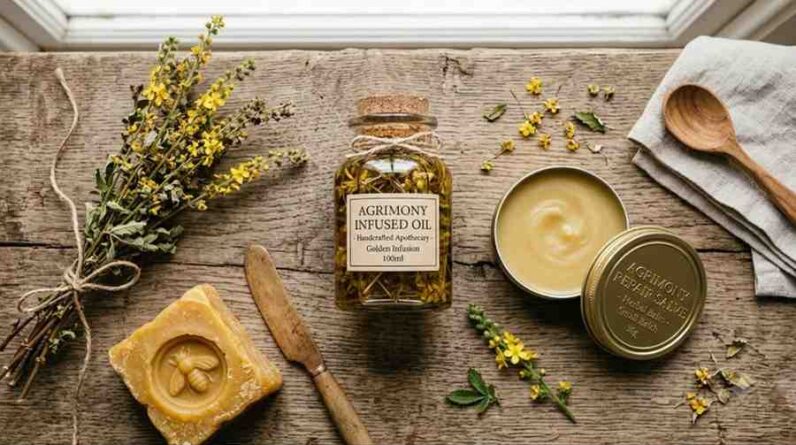
A scraped knee, a garden nick, a stubborn patch of dry skin: most of us reach for a store-bought ointment before we think about what’s actually in it. Agrimony salve is a simple, homemade healing salve you can put together with three main ingredients: dried agrimony, a carrier oil, and beeswax. It draws on the power of herbs used for centuries in folk medicine, backed by modern research into agrimony’s antibacterial and skin-repairing properties. Below, you’ll learn how to make herbal salves from scratch, step-by-step, plus how to store one safely and which other herbs pair well with agrimony. It’s written for anyone who wants to start making their own natural remedies at home, no lab coat required.
Quick Answer
Agrimony salve is a semi-solid herbal ointment made by infusing dried agrimony in a carrier oil, then thickening it with beeswax. Research on agrimony extracts shows they can speed wound closure and reduce bacterial colonization on skin. A basic healing salve recipe uses roughly 1 part beeswax to 4 to 5 parts herb-infused oil.
What Is Agrimony, and Why Put It in a Salve?
Agrimony (Agrimonia eupatoria) is a tall, yellow-flowered hedgerow herb that’s easy to grow and has long been used to treat cuts, grazes, and minor skin conditions. For the full plant profile, our guide to Agrimonia eupatoria covers its history, identification, and other uses in more depth.
The reputation isn’t only folklore. Laboratory research has found that agrimony extracts show measurable antibacterial activity against common wound pathogens, including Staphylococcus aureus and Pseudomonas aeruginosa, with tannins and flavonoids in the plant linked to faster collagen formation and reduced bacterial colonization on skin. A separate review found that a wound dressing built around agrimony water extract closed wounds faster than both a standard dressing and a manuka honey hydrogel it was tested against. That’s a solid reason to consider a simple herbal salve over a plain petroleum-based ointment.
None of this means agrimony salve replaces medical care for serious wounds. It’s best suited to minor scrapes and abrasions, insect bites and stings, rashes, and general dry or irritated skin, not deep cuts, burns, or anything that looks infected.
What You’ll Need
- 1 cup herb-infused oil (agrimony, or an agrimony blend, see below)
- 2 to 3 tablespoons beeswax (pastilles melt faster than a block)
- Optional: 1 teaspoon vitamin E oil, to help extend shelf life
- Optional: 15 to 20 drops essential oil, such as lavender or tea tree
- A double boiler or a heatproof bowl set over a pot of water
- Cheesecloth, for straining
- Small tins or a mason jar, for storage
This formula is flexible. You can build your salve with a single herb or multiple herbs, depending on what your skin needs.
Step 1: Make Your Herb-Infused Oil
Before you can make a salve, you need herb-infused oil, and this step takes the most patience.
Solar (cold) infusion: Fill a clean, dry jar about three-quarters full with dried agrimony, then cover the herb completely with your chosen carrier oil: olive, sweet almond, or jojoba oil all work well. Cap the jar and set it in a sunny window for 2 to 3 weeks, turning it once a day to keep the herb submerged. Strain through cheesecloth, squeezing out as much oil as you can, and compost the spent plant matter.
Heat (quick) infusion: Combine the dried herb and oil in a double boiler and warm gently on low heat for 2 to 3 hours, checking often so it never simmers. Strain the same way once it’s cooled.
Either method works. The solar infusion draws out slightly more of the plant’s compounds, while the heat method gets you usable herbal oil in an afternoon. If you’d rather skip this step, our herb-infused olive oil guide walks through both methods in more detail, including how to avoid the mistakes that cause infused oils to spoil.
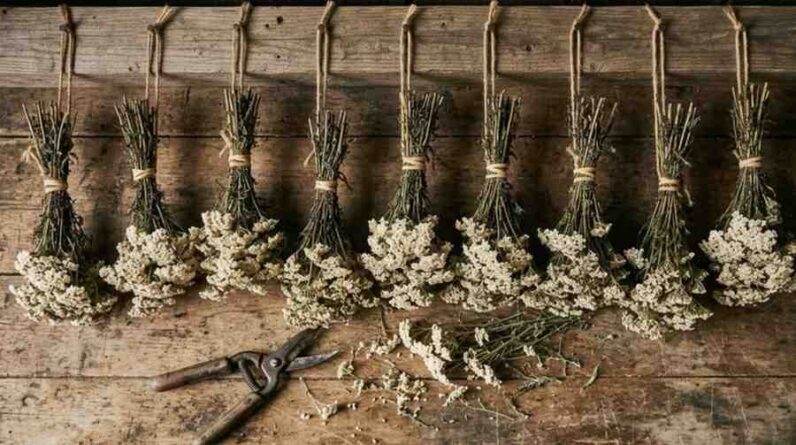
One safety note worth repeating: always infuse with fully dried herbs, not fresh ones. Fresh plant material carries moisture, and moisture trapped in oil is what invites mold and bacterial growth, which is also why Mountain Rose Herbs recommends dried herbs for any oil you plan to store rather than fresh-cut plant matter.
Step 2: Making Your Salve
Once your agrimony-infused oil is ready, turning it into a salve takes about 15 minutes.
- Measure 1 cup of infused oil into your double boiler.
- Add beeswax and warm on low heat, stirring occasionally, until the wax fully melts into the oil.
- Stir in vitamin E oil, if using, once the mixture is off the heat.
- Test the consistency: drop a small spoonful onto a plate or spoon that’s been in the freezer, and let it sit for a minute. Too soft? Remelt and add more beeswax. Too firm? Add a little more oil.
- Stir in essential oil, if using, then pour the warm salve into tins or a mason jar.
- Let it cool to room temperature, uncovered, before capping. This keeps condensation from forming inside the lid.
A 1:4 or 1:5 ratio of beeswax to oil makes a soft, easily spreadable salve; go closer to 1:3 for something firmer for a travel tin. Salves are simple to make, and once you’ve got the ratio down, you can easily craft a fresh batch anytime you have infused oil on hand.
Storage, Shelf Life, and Safety
Stored in a cool, dry place out of direct sunlight, a beeswax-based agrimony salve typically keeps for 6 to 12 months. Keep the lid on tight, and scoop with clean, dry fingers or a small spatula rather than wet hands, which reintroduces the moisture you worked to avoid during infusion.
A couple of safety notes worth taking seriously. Patch-test any new salve on a small area of skin first, especially if you’ve added essential oils, since they’re far more concentrated than the infused oil and can irritate sensitive skin. And an occlusive, oil-based salve isn’t right for a wound that’s actively infected or draining; sealing that kind of wound can trap bacteria rather than help it heal. Save agrimony salve for scrapes, dry or irritated skin, rashes, and bites, not deep or infected wounds.
Other Herbs to Pair With Agrimony
Agrimony blends well with other skin-supportive herbs, so you don’t have to use it alone:
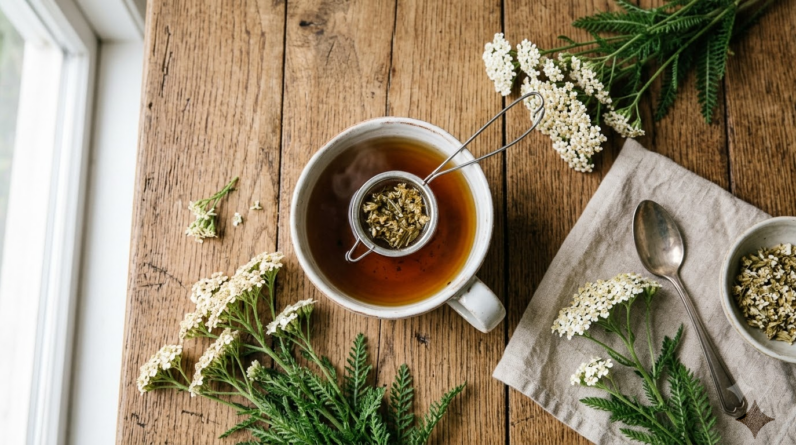
- Yarrow: traditionally used to treat wounds for its astringent, wound-closing properties
- Calendula: soothes irritated skin and rashes, and is one of the gentlest options for sensitive skin
- Plantain: a common “weed” prized for drawing out splinters and calming insect bites and stings
- Comfrey: supports healing for bruises, sprains, and strains; see our comfrey poultice guide for another way to use this herb
- St. John’s Wort: often infused for nerve-related pain and minor burns
- Arnica: better suited to unbroken skin, to help reduce inflammation from bruises and muscle pain
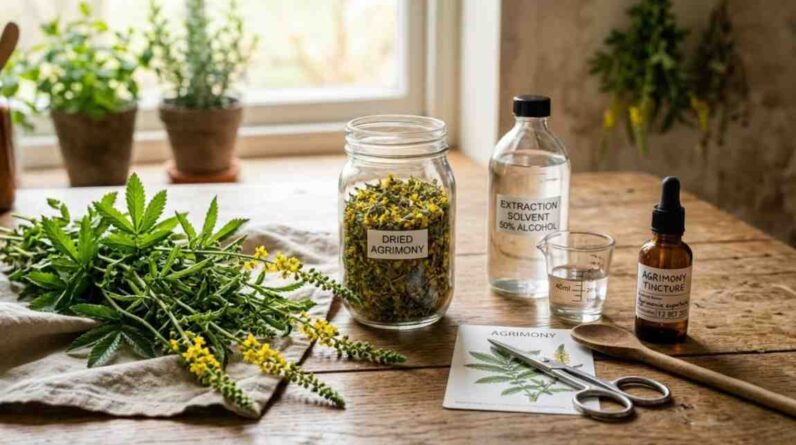
If you’d rather take agrimony’s astringent properties in a more concentrated, shelf-stable form, our agrimony tincture guide covers the alcohol-based extraction method.
For a stronger blend, infuse two or three of these herbs together in the same jar of oil rather than making separate batches. You can also stir in a spoonful of shea butter for a creamier finish, closer to a cream or lotion than a firm salve, if that’s the texture you prefer.
Frequently Asked Questions
You can, but dried is safer for infused oils meant for storage, since fresh plant matter carries water that can lead to mold. If you only have fresh agrimony, use the heat-infusion method and plan to use the finished salve within a few weeks.
You can, but dried is safer for infused oils meant for storage, since fresh plant matter carries water that can lead to mold. If you only have fresh agrimony, use the heat-infusion method and plan to use the finished salve within a few weeks.
Agrimony is generally considered gentle, but any new topical product should be patch-tested first, and it’s worth checking with a pediatrician before using it on infants or on broken skin.
Yes. Essential oils add scent and, in some cases, extra antibacterial action, but they’re entirely optional. A plain agrimony salve made with just infused oil and beeswax works fine on its own.
It comes down to your beeswax-to-oil ratio. Remelt the batch on low heat and add more beeswax for a firmer salve, or more oil for a softer one, testing on a cold spoon until it feels right.
Final Thoughts
Agrimony salve is one of the more forgiving projects in home herbalism: three ingredients, no special equipment, and a finished product you’ll actually reach for. Once you’ve got the basic ratio down, it’s easy to swap in yarrow, calendula, or comfrey depending on what your skin needs that week, and a batch of finished tins also makes a great gift for anyone who likes natural remedies. If you haven’t tried the herb in other forms yet, our agrimony tea guide is a good next stop, since brewing the tea is the simplest way to get to know the plant before you start infusing oils with it.
Disclaimer: This article is for educational purposes only and is not intended as medical advice. Always consult a qualified healthcare professional before using medicinal herbs, especially if you are pregnant, nursing, taking medications, or have a medical condition. Read our full Medical Disclaimer.
References
- Antibiofilm Activity of Agrimonia eupatoria Extracts Against Clinically Relevant Pathogens, PMC: https://pmc.ncbi.nlm.nih.gov/articles/PMC12921527/
- Phytotherapeutic insights into wound healing: unveiling the potential of Agrimonia eupatoria L., Phytochemistry Reviews: https://link.springer.com/article/10.1007/s11101-025-10203-9
- Agrimonia eupatoria L. and wound healing, ScienceDirect: https://www.sciencedirect.com/science/article/abs/pii/S2210803323001434
- How to Make Herbal Salves, Mountain Rose Herbs: https://blog.mountainroseherbs.com/diy-herbal-salves
- Making an Herbal Salve, Green Path Herb School: https://www.greenpathherbschool.com/greenpathblog/making-an-herbal-salve

Written by cskoch, who researches medicinal plants and herbal wellness at Herbal Daily Care. This guide is research-based: we reviewed published trials, meta-analyses, and the manufacturer’s own sales page. We did not purchase or test the product, and we do not claim first-hand results.