


This information is for educational purposes and isn’t intended to diagnose, treat, cure, or prevent any disease. See our Medical Disclaimer for more.
Quick Answer
Rosemary tea benefits include digestive support, antioxidant protection, and a mild boost to focus, thanks to compounds like rosmarinic acid and 1,8-cineole. One small clinical trial also found it may help lower blood sugar markers in people with type 2 diabetes. Brew 1-2 teaspoons of dried leaves in hot water for 8-10 minutes, up to twice daily.
Most people either grow rosemary for cooking or buy the dried leaves and never think to make tea from it. That’s a missed opportunity, because rosemary tea is one of the few herbal infusions with an actual clinical trial behind one of its most repeated claims.
This guide covers what rosemary tea can realistically do for digestion, blood sugar, and antioxidant intake, along with the exact steps to brew a cup properly. It’s written for anyone who already has rosemary on hand, whether from the garden or the spice rack, and wants to use it as more than a seasoning.
For the fuller picture on rosemary beyond tea, including the hair-growth research and aromatherapy studies, see our complete guide to rosemary herb health benefits.
What Rosemary Tea Actually Is
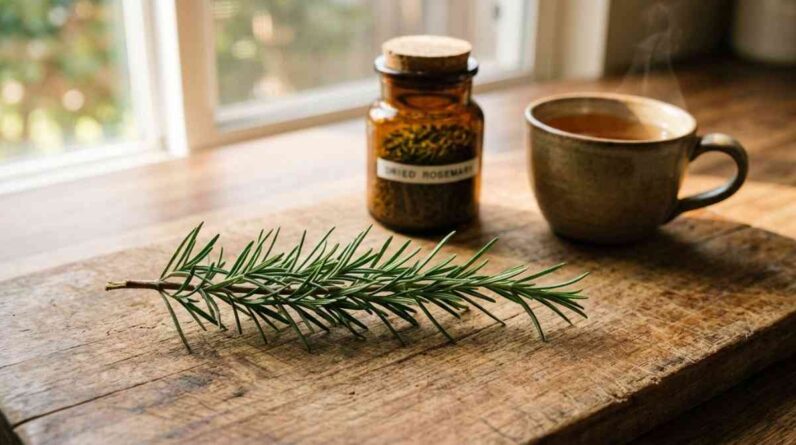
Rosemary tea is a simple infusion made by steeping fresh or dried rosemary leaves (Salvia rosmarinus) in hot water. It’s naturally caffeine-free and carries the same sharp, pine-like flavor as the fresh herb, just softened by the steeping process. Unlike rosemary essential oil or supplement capsules, tea delivers a much lower, food-level concentration of the plant’s active compounds.
Digestive Support
This is rosemary’s oldest documented use, and it’s backed by more than folklore.
The European Medicines Agency’s official monograph on rosemary leaf lists it as a traditional herbal product used for dyspepsia and mild spasmodic disorders of the digestive tract. That’s a formal regulatory classification, not just a home remedy claim, though it’s based on long-standing traditional use rather than modern clinical trials.
Rosemary tea works better than a strong coffee for settling a heavy meal, because it doesn’t add caffeine or acidity to an already-working stomach. A warm cup after dinner is the most common way people use it for this purpose.
If digestion is your main goal, rosemary pairs well with other herbs covered in our herbal remedies for bloating guide, since several work through a similar carminative mechanism.
Blood Sugar: What One Real Study Found
This is the claim you’ll see repeated across almost every rosemary tea article online, usually with no source attached. Here’s the actual trial behind it.
Researchers at a Mexican hospital gave forty people with type 2 diabetes rosemary tea, brewed at 2 grams of leaves per liter of water daily, alongside their existing metformin or glibenclamide treatment. After 90 days, the group saw a statistically significant drop in glycated hemoglobin (HbA1c), insulin resistance markers, and waist-hip ratio, along with reduced oxidative stress markers.
That’s a genuinely useful finding, and it’s a fair comparison point: rosemary tea showed a measurable effect on blood sugar markers over 90 days in this trial, in a way that plain herbal teas without active compounds typically don’t. But it’s one trial of forty people, run alongside standard diabetes medication rather than in place of it. It should not be read as a reason to adjust or stop any prescribed treatment.
If you have diabetes or take blood sugar medication, talk to your doctor before adding rosemary tea as a regular habit, since the interaction between herbal compounds and glucose-lowering drugs isn’t fully mapped out yet.
Antioxidant Content
Rosemary owes much of its reputation as a “healthy herb” to rosmarinic acid and carnosic acid, two compounds researchers have studied for their role in neutralizing oxidative stress. A review of rosemary’s health-promoting properties notes it’s long been used for its antioxidant and antimicrobial activity, strong enough that food manufacturers use rosemary extract commercially as a natural preservative.
Callout: Tea versus extract. Food preservative-grade rosemary extract is far more concentrated than what ends up in your cup after steeping leaves for ten minutes. Tea gives you a meaningful but modest dose, not the same intensity used in lab studies or commercial extracts.
Focus and Mood
Most of the research on rosemary and cognitive performance has studied the aroma, not the tea itself, so this benefit carries over more loosely.
A study out of Northumbria University found that rosemary aroma improved memory task performance compared with no scent at all, and a follow-up study linked higher blood levels of 1,8-cineole, one of rosemary’s aromatic compounds, to better performance on speed and accuracy tasks. Drinking rosemary tea means inhaling some of that same aroma while it’s hot, so there’s a reasonable, if smaller, crossover effect. It isn’t the same as sitting in a rosemary-scented room for a controlled test.
How to Brew Rosemary Tea
Getting the steeping time right matters more than people expect. Too short, and you miss most of the flavor and compounds. Too long, and it turns bitter.
- Bring a cup of water to a near-boil, just off a rolling boil.
- Add 1-2 teaspoons of dried rosemary leaves, or a 4-inch fresh sprig, lightly crushed to release the oils.
- Cover the cup and steep for 8-10 minutes.
- Strain out the leaves and drink warm.
- Add honey or a squeeze of lemon if the flavor is too sharp on its own.
| Method | Amount | Steep Time | Notes |
|---|---|---|---|
| Dried leaves | 1-2 tsp per cup | 8-10 minutes | Most consistent strength |
| Fresh sprig | One 4-inch sprig | 8-10 minutes | Lightly crush leaves first |
| Cold brew | 1 tbsp per 2 cups water | 6-8 hours, refrigerated | Milder, less bitter flavor |
If you’d rather have a steady fresh supply than keep buying dried leaves, rosemary is one of the easier herbs to keep going indoors year-round. Our guide to the best medicinal herbs to grow indoors covers container size, light, and watering for it.
How Much Is Safe to Drink
One to two cups a day is generally well tolerated for healthy adults. There isn’t strong research on higher daily amounts, so drinking more doesn’t necessarily mean more benefit, and very high intake has been associated with digestive upset in some people.
Rosemary is one of the herbs commonly recommended for regular use in moderate amounts. If you’re building a small rotation of herbs you drink or cook with regularly, our what herbs are safe for everyday use guide is a useful next stop.
Who Should Be Cautious
- Pregnant women: medicinal-strength rosemary is commonly advised against during pregnancy; occasional culinary tea is generally considered lower-risk, but check with your doctor first.
- People on blood-thinning or blood pressure medication: rosemary may interact with these, so more than an occasional cup warrants a conversation with a healthcare provider.
- People with diabetes on medication: as noted above, don’t treat rosemary tea as a substitute for prescribed treatment.
Our Verdict
Rosemary tea earns a place in a regular herbal rotation. The digestive use has centuries of traditional backing and an official regulatory classification behind it, and the blood sugar research, while limited to one study, is a real and specific finding worth knowing about. Where it falls short of the hype is cognition: most of that evidence is about the aroma, and tea only partially captures it. Treat rosemary tea as a genuinely useful daily habit, not a treatment for any condition.
Frequently Asked Questions
Does rosemary tea actually help digestion? Yes, this is its best-documented traditional use. The European Medicines Agency formally lists rosemary leaf as a traditional herbal product for dyspepsia and mild digestive spasms, based on long-standing use rather than modern trials.
Can rosemary tea lower blood sugar? One 2019 clinical study of forty people with type 2 diabetes found that rosemary tea, taken alongside standard medication for 90 days, was linked to lower HbA1c and insulin resistance markers. It’s a single study, so it supports rosemary tea as a possible complement, not a replacement for diabetes treatment.
How many cups of rosemary tea can I drink a day? One to two cups is generally considered well tolerated for healthy adults. There isn’t solid research supporting higher daily amounts.
Can I use fresh rosemary from my garden instead of dried? Yes, a lightly crushed 4-inch fresh sprig works well, steeped for 8-10 minutes, similar to using 1-2 teaspoons of dried leaves.
Is rosemary tea safe to drink every day? For most healthy adults, 1-2 cups daily is considered reasonable. Pregnant women, people on blood-thinning or blood sugar medication, and anyone with a chronic condition should check with a doctor before making it a daily habit.
Next Up
If you want the full picture on what rosemary can do beyond tea, including the essential oil research on hair growth, our rosemary herb health benefits guide covers it in depth. For more beginner-friendly herbs worth having on hand, see our 20 best medicinal herbs for beginners.
References
- Quirarte-Báez, S.M., et al. (2019). A shortened treatment with rosemary tea (Rosmarinus officinalis) instead of powder decreases insulin resistance and serum glucose in patients with diabetes mellitus type 2 (T2D). Journal of Population Therapeutics & Clinical Pharmacology, 26(4). https://jptcp.com/index.php/jptcp/article/view/634
- European Medicines Agency. Rosmarini folium (rosemary leaf) — herbal medicinal product overview. https://www.ema.europa.eu/en/medicines/herbal/rosmarini-folium
- Moss, M., & Oliver, L. (2012). Plasma 1,8-cineole correlates with cognitive performance following exposure to rosemary essential oil aroma. Therapeutic Advances in Psychopharmacology. https://pmc.ncbi.nlm.nih.gov/articles/PMC3736918/
- Moss, M., Cook, J., Wesnes, K., & Duckett, P. (2003). Aromas of rosemary and lavender essential oils differentially affect cognition and mood in healthy adults. International Journal of Neuroscience. https://pubmed.ncbi.nlm.nih.gov/12690999/
- Andrade, J.M., et al. Rosemary (Salvia rosmarinus): Health-promoting benefits and food preservative properties. PMC. https://pmc.ncbi.nlm.nih.gov/articles/PMC8513767/

Researches medicinal plants, herbal wellness, and sustainable gardening practices. Through Herbal Daily Care, she helps readers discover the benefits of growing and using herbs at home.