



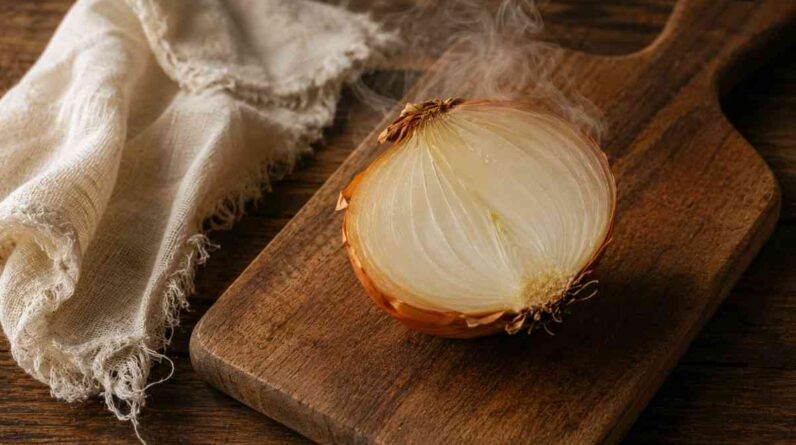
An earache at 2 a.m. has a way of sending most of us straight to the kitchen for whatever might help. An onion poultice, sometimes called an onion compress, is one of the oldest home remedies for ear pain, passed down for generations as a way to ease discomfort while the body’s own healing process fights off the underlying infection. This guide covers how to make one, what it can realistically do, and where the safety line sits, because that part matters more than the recipe itself. Used alongside conventional treatment rather than in place of it, it may be a genuinely helpful comfort measure for a rough night.
Quick Answer
An onion poultice is a warm, wrapped compress of cooked or heated onion held against the outer ear (never inside the ear canal) for 10–15 minutes to ease earache discomfort. It may offer temporary pain relief from warmth and onion’s mild anti-inflammatory compounds, but it doesn’t treat the underlying ear infection and isn’t a substitute for a healthcare provider’s diagnosis.
What Is an Onion Poultice, and What Can It Actually Do for an Earache?
A poultice is warm, softened plant material wrapped in cloth and applied against the skin. For an earache, that means chopped or halved onion, gently heated until soft and juicy, wrapped in a thin cloth, and held against the outer ear rather than placed in the ear canal itself.
Why people reach for onion
Onions belong to the allium family, along with garlic, and they contain sulfur compounds along with quercetin, a plant compound with mild anti-inflammatory activity. The traditional reasoning behind an onion poultice is twofold: the warmth itself is meant to increase blood flow to the area and tends to feel soothing on a sore ear, and onion’s antibacterial properties are believed to help reduce inflammation and ease pain when applied to skin. It’s worth being direct here: scientific evidence for onion easing ear pain is limited to traditional use and anecdotal reports rather than clinical trials, so treat this as a comfort measure with a plausible mechanism, not a proven treatment. Skip this remedy entirely if you have a known onion allergy.
What it doesn’t do
An onion poultice does not treat the underlying ear infection. Most middle ear infections are caused by a bacterium or virus behind the eardrum, often after nasal congestion and mucus buildup from a cold blocks the eustachian tube and irritates the mucous membranes lining it, letting fluid build up behind the eardrum. A compress against the outside of the ear has no way to reach or clear any of that. If a bacterial infection needs an antibiotic, only a healthcare provider or other healthcare professional can make that call after an exam, and no home remedy is a substitute for professional medical advice, diagnosis, or treatment. Onion’s warming property may relieve discomfort in the meantime, but that’s a different thing entirely from treating the infection. Note that this is a separate issue from earwax buildup, which is unrelated and also shouldn’t be treated with a poultice.
How to Make an Onion Poultice for Ear Pain
- Peel and roughly chop or slice one onion into small pieces, or cut it in half if you’d rather keep it whole.
- Warm the onion gently, either sautéing the small pieces in a little oil for a few minutes, steaming them briefly, or roasting the halved onion in the oven until it softens and turns juicy.
- Let it cool just enough to handle safely. Test the temperature against the inside of your wrist first, it should feel warm, not hot.
- Wrap the warm onion in a thin cloth, such as a flour-sack towel or muslin, so no juice or pieces touch the skin directly. Some people blend the warmed onion into a rough paste first, for an even, comfortable fit against the ear.
- Apply the poultice gently against the outer ear and the skin around it, never inside the ear canal.
- Leave it in place for 10–15 minutes, then remove.
- Repeat a few times a day if it’s helping with comfort, and it can be reheated and reused multiple times, just use a clean cloth for each application.
Safety First: What to Know Before You Try This
Never put onion, juice, or drops inside the ear canal
This is the single most important rule. Some older folk instructions describe squeezing onion juice into the ear as drops. Don’t do this. If the eardrum has any tear or perforation, which is a real possibility with a more severe ear infection, introducing onion juice into the middle ear space could cause additional irritation or harm. Keep the poultice against the outer ear and the skin around it, not inside the canal itself.
When to see a healthcare provider instead
Ear infections are common, especially in young children, and most resolve well with appropriate care. But certain symptoms mean a home remedy isn’t enough on its own, and a healthcare provider should be seen instead:
- Fever of 102°F or higher
- Any pus, discharge, or fluid draining from the ear
- Pain that’s severe or getting worse instead of better
- Symptoms lasting more than 2–3 days
- Any sign of hearing loss
- An infant under 3 months old with any fever
If your child (or you) has any of these, an onion poultice is not the right next step, seeing a healthcare provider is. And a quick note that applies to any home remedy: never give aspirin to a child with a fever or viral illness, due to the risk of Reye’s syndrome, use children’s acetaminophen or ibuprofen instead, per your provider’s dosing guidance.
Other Home Treatments Worth Trying Alongside It
An onion poultice doesn’t have to stand alone. Other home treatments, like the onion poultice, are meant for comfort rather than cure, and a few are commonly used alongside it while the body recovers:
- A plain warm compress or warm cloth against the ear works through the same warmth mechanism as the onion poultice, without the onion, if you’d rather keep things simple.
- Over-the-counter pain relief (acetaminophen or ibuprofen, dosed appropriately for age and weight) is one of the most reliable ways to ease ear pain while an infection runs its course.
- Staying upright rather than lying flat can help reduce pressure buildup in the middle ear.
- Garlic oil is another traditional remedy some people use, though like onion, there’s no strong scientific evidence behind it, and it should never go into the ear canal either.
- Mullein-infused oil is a traditional herbal ear-drop option some people turn to, though evidence is similarly limited, and any ear drop should be avoided if you suspect the eardrum could be perforated.
- Herbal teas like echinacea are sometimes used to support the immune system generally during a cold or respiratory tract infection that preceded the ear infection, though they don’t treat the ear infection directly.
- Since the throat and ear share drainage pathways, treating an accompanying sore throat with warm fluids, tea, or even a warmed poultice applied to the front of the neck can indirectly ease the congestion that often underlies an earache in the first place. If that congestion lingers well after a cold has otherwise cleared up, that’s often exactly what’s driving the ear symptoms.
None of these replace a diagnosis. They’re comfort measures to use while you wait to see whether symptoms improve on their own or need a healthcare provider’s attention.
If sprains, strains, or bruises are more your household’s usual first-aid need, our guide to making a comfrey poultice covers the same basic technique applied to a different kind of ache.
Why Ear Infections Are So Common in Young Children
This remedy comes up most often for kids, and there’s a real anatomical reason for that. Children’s eustachian tubes, the narrow channels that drain the middle ear, are shorter, narrower, and sit more horizontally than an adult’s. That makes them easier to block and slower to drain once a cold sets in, which is exactly why middle ear infections cluster so heavily in children under two. It’s also why the same congestion that starts as a stuffy nose so often ends up as an earache a day or two later. Knowing that pattern can help you catch symptoms early, whether you reach for an onion poultice, a plain warm compress, or a call to your child’s healthcare provider.
Frequently Asked Questions
It may ease earache discomfort through warmth and onion’s mild anti-inflammatory compounds, but it doesn’t treat the underlying infection itself. Think of it as comfort support, not treatment.
Warm chopped or halved onion until soft and juicy, wrap it in a thin cloth, and hold it against the outer ear (not inside the ear canal) for 10–15 minutes.
No. Onion juice or pieces should never go inside the ear canal, especially if there’s any chance the eardrum has a tear. Keep the poultice against the outside of the ear only.
See a healthcare provider for a fever of 102°F or higher, any discharge or fluid draining from the ear, worsening or severe pain, symptoms lasting more than 2–3 days, hearing loss, or an infant under 3 months old with any fever.
A plain warm compress, age-appropriate over-the-counter pain relief, staying upright rather than lying flat, and treating an accompanying sore throat or cold can all help with comfort while the infection runs its course.
Conclusion
An onion poultice is a gentle, low-cost home remedy that may take the edge off earache discomfort through warmth alone, but it’s a comfort measure, not a cure. We’ve checked the safety guidance above for accuracy against CDC and Mayo Clinic sources. Keep it on the outside of the ear, watch for the warning signs above, and don’t hesitate to see a healthcare provider if the pain, fever, or drainage tells you this needs more than a kitchen remedy.
Disclaimer: This article is for educational purposes only and is not intended as medical advice. Always consult a qualified healthcare professional before using medicinal herbs, especially if you are pregnant, nursing, taking medications, or have a medical condition. Read our full Medical Disclaimer.
References
- CDC, “Ear Infection Basics” — https://www.cdc.gov/ear-infection/about/index.html
- Mayo Clinic, “Ear infection (middle ear) – Symptoms and causes” — https://www.mayoclinic.org/diseases-conditions/ear-infections/symptoms-causes/syc-20351616
- Mayo Clinic, “Ear infection (middle ear) – Diagnosis and treatment” — https://www.mayoclinic.org/diseases-conditions/ear-infections/diagnosis-treatment/drc-20351622
- SingleCare, “Home remedies for ear pain relief” — https://www.singlecare.com/blog/ear-pain-relief/

Researches medicinal plants, herbal wellness, and sustainable gardening practices. Through Herbal Daily Care, she helps readers discover the benefits of growing and using herbs at home.