


Quick Answer
Rosemary herb health benefits include memory and focus support from its aroma, antioxidant protection from rosmarinic and carnosic acid, and possible hair growth support comparable to minoxidil in one clinical trial. Most benefits come from brewed tea, culinary use, or diluted essential oil. It’s generally safe in food amounts, though concentrated oil and high-dose supplements need more caution.
If you’ve ever rubbed a sprig of rosemary between your fingers and felt instantly more awake, you weren’t imagining things. That sharp, pine-like scent has a real effect on your brain, and it’s one of the few kitchen herbs with actual clinical research behind it.
This guide walks through what rosemary can genuinely do for memory, inflammation, skin, hair, and digestion, based on published studies rather than folklore. It also covers realistic ways to use it and where the evidence runs thin. It’s written for anyone who wants more than a “rosemary is great for everything” list, whether you already grow it or you’re just curious before buying a bottle of the oil.
What Is Rosemary?
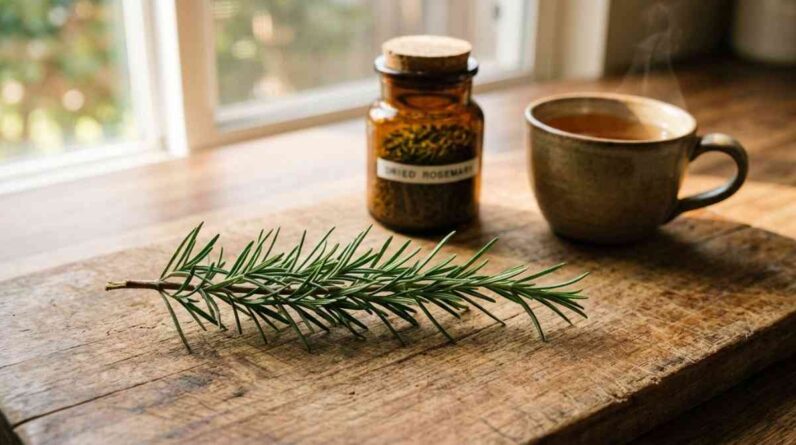
Rosemary (Salvia rosmarinus, formerly Rosmarinus officinalis) is a woody, needle-leafed evergreen shrub native to the Mediterranean. It has been used as both a culinary herb and a folk remedy for centuries, most famously as the “herb of remembrance.” Its active compounds, mainly rosmarinic acid and carnosic acid, are what researchers focus on when studying its effects on the body and brain.
Rosemary and Memory: The Best-Studied Benefit
This is where rosemary has the most solid science behind it, and it’s a good place to start before moving into the broader rosemary herb health benefits people ask about.
In a widely cited trial, researchers at Northumbria University had participants complete cognitive tests in rooms scented with rosemary essential oil, lavender, or no scent at all. The study compared how lavender and rosemary aromas affected cognitive performance and mood in 144 healthy adults completing a computerized test battery in a room diffused with one of the two oils or no scent. Rosemary produced a measurable improvement in overall memory quality and secondary memory, though it also slowed participants down slightly on memory-related tasks.
A follow-up study went a step further and looked at what was actually happening in participants’ blood. Mark Moss and Lorraine Oliver had twenty healthy volunteers perform subtraction and visual processing tasks in a room scented with rosemary, then drew blood to measure levels of 1,8-cineole, one of rosemary’s main aromatic compounds. They found that people with higher blood concentrations of 1,8-cineole performed better on both speed and accuracy measures, suggesting the compound itself, not just the smell, was doing something to cognitive function.
Rosemary aroma is better than lavender for staying sharp during a task, while lavender works better for winding down before sleep. That’s a useful distinction if you’re choosing an essential oil for your desk versus your nightstand. For a side-by-side look at how these two herbs differ more broadly, our Chamomile vs Lavender comparison covers similar ground for evening use.
None of this means rosemary is a nootropic supplement or a substitute for sleep and good habits. The effect size in these studies is modest, and most of the research measures short bursts of aroma exposure rather than long-term supplementation.
Antioxidant and Anti-Inflammatory Effects
Rosemary’s reputation as a “healing herb” mostly traces back to two compounds: rosmarinic acid and carnosic acid.
Rosemary has traditionally been used as an anti-inflammatory and analgesic agent and is currently being studied for anti-cancer and hepatoprotective properties, along with its established role as a natural food preservative thanks to strong antioxidant and antimicrobial activity. The diterpenes carnosol and carnosic acid are two of the most abundant compounds in the herb and account for the large majority of its antioxidant capacity.
Rosmarinic acid gets attention for a different reason: its potential role in protecting cells from oxidative damage. Along with related compounds from herbs like sage, thyme, and lavender, it’s been studied for anti-inflammatory, antioxidant, antidepressant, and antiallergy properties. Early research has also looked at whether rosmarinic acid can support healthy blood sugar regulation, though this work is still mostly in cell and animal models rather than large human trials.
Callout: What “antioxidant” actually means here. Antioxidants neutralize unstable molecules called free radicals before they damage cells. Rosemary’s antioxidant content is well-documented in lab settings. What’s less settled is how much of that benefit survives digestion when you eat rosemary in food versus applying concentrated extract directly.
If you’re building out a small collection of everyday herbs with this kind of research-backed profile, our guide to herbs that are safe for everyday use is a good next stop, since rosemary is one of the herbs discussed there for regular kitchen use.
Rosemary and Hair Growth
This is the benefit that gets shared the most, and it’s worth being precise about what the actual study found.
Researchers randomly assigned 100 people with androgenetic alopecia to use either rosemary oil or minoxidil 2% for six months, taking standardized photographic measurements at the start, three months, and six months. Neither group saw a significant change in hair count at three months, but both groups showed a significant increase by six months compared with baseline. There was no meaningful difference in hair count between the rosemary and minoxidil groups at either checkpoint. Scalp itching increased in both groups over time, but it was reported more often in the minoxidil group at both time points.
That’s a genuinely useful finding: rosemary oil performed on par with minoxidil 2% for hair count after six months, with fewer itching complaints. It’s a real comparison worth citing when discussing natural hair-growth alternatives.
But there are limits worth knowing before you buy a bottle. The trial only had 100 participants, it compared rosemary to minoxidil 2% rather than the more commonly used 5% strength, and it tested pure rosemary essential oil applied directly to the scalp rather than infused oils or rosemary shampoo. Results from one form don’t automatically carry over to another.
If you plan to try it, dilute rosemary essential oil in a carrier oil like jojoba or coconut oil before scalp application. Undiluted essential oil can irritate skin.
Digestion, Skin, and Other Traditional Uses
Beyond memory and hair, rosemary shows up in traditional use for several other purposes, though the human clinical evidence here is thinner.
- Digestive comfort. Rosemary tea is a long-standing folk remedy for bloating and sluggish digestion, often grouped with herbs like peppermint and fennel. If digestion is your main concern, our roundup of herbal remedies for bloating covers several options with more direct research behind them.
- Skin and food preservation. Rosemary extract is used commercially as a natural preservative in cosmetics and packaged foods because of its antimicrobial and antioxidant properties.
- Liver support. Animal studies have looked at rosemary essential oil’s protective effects on liver tissue exposed to toxins, though this hasn’t been confirmed in human trials at meaningful doses.
None of these traditional uses are as well-studied as the memory or hair growth research, so treat them as supporting evidence rather than settled fact.
How to Use Rosemary: Practical Options
| Method | Best For | Notes |
|---|---|---|
| Fresh or dried culinary use | General wellness, flavor | Easiest and lowest-risk option |
| Rosemary tea | Digestion, mild focus | 1-2 cups per day is generally well tolerated |
| Diluted essential oil (topical) | Scalp/hair, aromatherapy | Always dilute in a carrier oil first |
| Rosemary aroma/diffuser | Memory, alertness during tasks | Short exposure sessions match the research design |
| Standardized extract/capsule | Antioxidant support | Least amount of human dosing research; talk to a doctor first |
Numbered steps for a simple rosemary tea:
- Bring a cup of water to a near-boil.
- Add 1-2 teaspoons of fresh or dried rosemary leaves.
- Cover and steep for 8-10 minutes.
- Strain and drink warm, up to twice a day.
For a full step-by-step, including brewing ratios, cold-brew method, and what the research says about rosemary tea specifically, see our guide to rosemary tea benefits and how to brew it right.
If you’d rather grow your own supply than keep buying dried rosemary, it’s one of the easier herbs to keep alive indoors. Our guide to the best medicinal herbs to grow indoors walks through container setup and light requirements, and rosemary is a strong pick if you’re just starting out, alongside the options in our best herbs to start with for health list.
Safety and Precautions
Culinary amounts of rosemary in food are considered safe for most people. Concentrated forms deserve more caution:
- Undiluted essential oil can irritate skin and shouldn’t be taken internally.
- High doses have been linked to digestive upset in some people.
- Rosemary may interact with blood-thinning medication and certain blood pressure drugs, so check with a doctor before using concentrated extract if you’re on prescription medication.
- Pregnant women are often advised to avoid medicinal (non-culinary) doses of rosemary, since traditional use includes it as a menstrual stimulant.
This isn’t medical advice. If you have an existing condition or take medication regularly, run any new herbal routine past a healthcare provider first.
Our Verdict
Rosemary earns its reputation, but not for every claim attached to it. The memory and alertness research is genuinely solid for a culinary herb, the hair growth comparison to minoxidil is a real and interesting finding from a properly controlled trial, and the antioxidant content is well documented in lab studies. Where the evidence thins out is in the bigger claims: cancer prevention, liver protection in humans, and long-term supplement dosing. Use rosemary as a well-supported daily herb and aromatic tool, not a cure-all.
Frequently Asked Questions
Does rosemary actually help memory, or is that just folklore? There’s real clinical research behind it. Studies out of Northumbria University found that rosemary aroma improved memory task performance in healthy adults, and a related study linked higher blood levels of rosemary’s 1,8-cineole compound to better cognitive performance.
Is rosemary oil really as effective as minoxidil for hair loss? In one 2015 randomized trial of 100 people with androgenetic alopecia, rosemary oil produced hair count improvements similar to minoxidil 2% after six months, with less reported scalp itching. It’s one study, so it supports rosemary as a promising option rather than a proven equivalent.
How much rosemary tea can I drink per day? One to two cups a day is generally considered well tolerated for most healthy adults. There isn’t strong dosing research for higher amounts, so more isn’t necessarily better.
Can I apply rosemary essential oil directly to my scalp or skin? No, undiluted essential oil can irritate skin. Mix it with a carrier oil like jojoba, coconut, or olive oil before applying it to your scalp or skin.
Is rosemary safe during pregnancy? Culinary amounts in cooking are generally considered fine, but medicinal or concentrated doses are commonly advised against during pregnancy. Check with your doctor before using rosemary supplements or essential oil while pregnant.
Next Up
If you’re building a small herbal routine around evidence-backed, easy-to-grow plants, rosemary pairs well with the other everyday herbs covered in our what herbs are safe for everyday use guide. For a broader starting list, see our 20 best medicinal herbs for beginners.
References
- Moss, M., Cook, J., Wesnes, K., & Duckett, P. (2003). Aromas of rosemary and lavender essential oils differentially affect cognition and mood in healthy adults. International Journal of Neuroscience. https://pubmed.ncbi.nlm.nih.gov/12690999/
- Moss, M., & Oliver, L. (2012). Plasma 1,8-cineole correlates with cognitive performance following exposure to rosemary essential oil aroma. Therapeutic Advances in Psychopharmacology. https://pmc.ncbi.nlm.nih.gov/articles/PMC3736918/
- Panahi, Y., Taghizadeh, M., Marzony, E.T., & Sahebkar, A. (2015). Rosemary oil vs minoxidil 2% for the treatment of androgenetic alopecia: a randomized comparative trial. SKINmed. https://pubmed.ncbi.nlm.nih.gov/25842469/
- Andrade, J.M., et al. Rosemary (Salvia rosmarinus): Health-promoting benefits and food preservative properties. PMC. https://pmc.ncbi.nlm.nih.gov/articles/PMC8513767/
- Rosmarinic acid biological roles review: Implications in Diabetes, Cancer and Neurodegenerative Diseases. PMC. https://pmc.ncbi.nlm.nih.gov/articles/PMC10574478/

Researches medicinal plants, herbal wellness, and sustainable gardening practices. Through Herbal Daily Care, she helps readers discover the benefits of growing and using herbs at home.