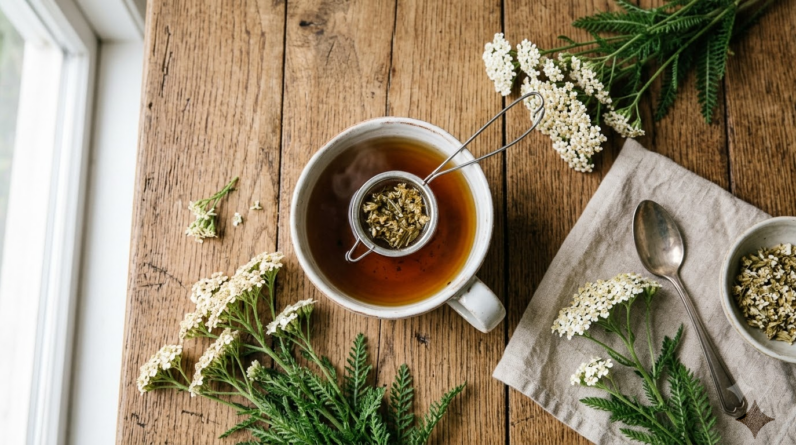


Tea is the gentlest way to use agrimony, but it’s not the strongest one. A tincture concentrates the herb’s tannins and flavonoids into a shelf-stable liquid that lasts for years and travels in a pocket. Making an agrimony tincture at home is genuinely simple: dried herb, alcohol, a jar, and patience. This guide walks through the folk-method ratio, the maceration process, dosage, and how the finished extract can be used both internally and on the skin. If you haven’t already covered the basics of the plant itself, our Agrimonia Eupatoria guide is the place to start, and our how-to-make-agrimony-tea guide covers the milder infusion version.
Quick Answer
An agrimony tincture is a concentrated liquid extract made by soaking dried Agrimonia eupatoria herb in high-proof alcohol for several weeks, then straining. The standard folk-method ratio is one part dried herb to five parts alcohol (1:5), macerated for 4 to 6 weeks. It’s used internally at 5 to 10 ml per dose, or diluted for topical wound care.
What Is an Agrimony Tincture?
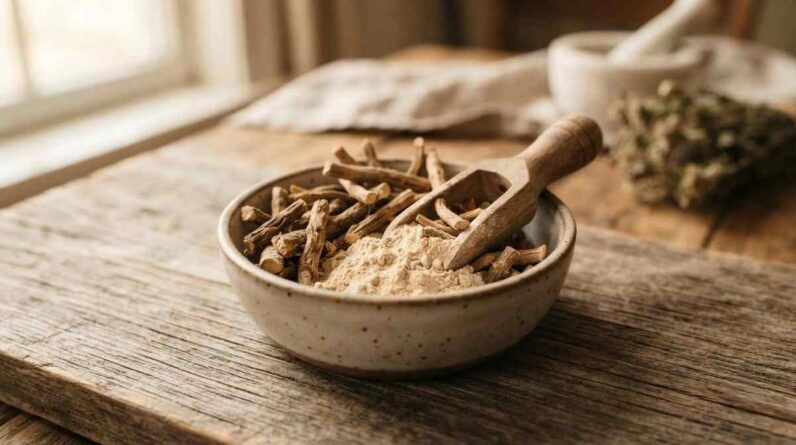
An agrimony tincture is a liquid extract made by soaking dried, cut and sifted agrimony herb, harvested from the plant’s stems, leaves, and small yellow star-shaped flowers, in alcohol until its active compounds, mainly tannins and flavonoids, dissolve into the liquid. This process, called maceration, pulls out a broader and more concentrated range of plant material than hot water alone can manage, which is why agrimony has stayed a well-regarded medicinal plant in herbal medicine circles, and why herbalists reach for tinctures when they want a stronger, longer-lasting way to capture the benefits of agrimony than tea offers.
Unlike a decoction or infusion, which needs to be made fresh every few days, a properly made agrimony tincture keeps for several years if stored correctly. That shelf life, combined with its small dose size, is the main reason tinctures have stayed a core method in Western herbalism for centuries, right alongside teas and washes.
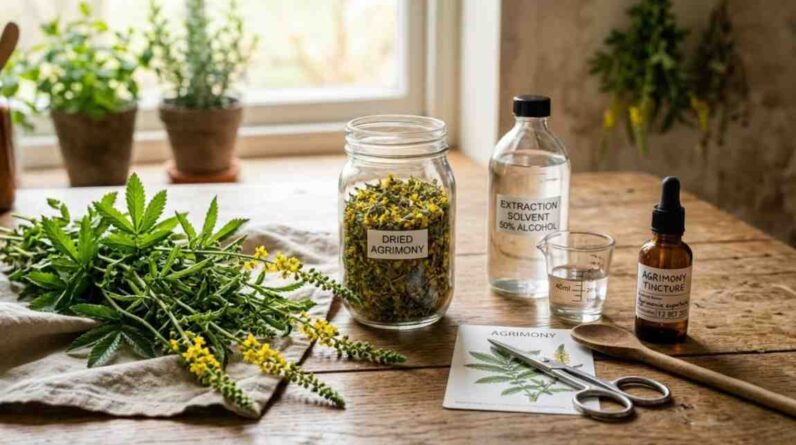
What You’ll Need
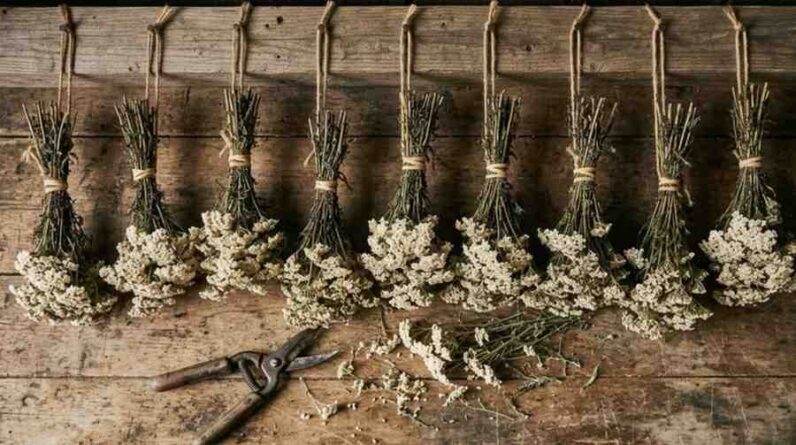
- 1 part dried, cut, and sifted agrimony herb (by weight)
- 5 parts high-proof alcohol, such as 80 to 100 proof (40 to 50% ABV) vodka
- A clean glass jar with a tight-fitting lid
- Cheesecloth or a fine mesh strainer
- Dark glass dropper bottles for storage
- A kitchen scale (a measuring cup works if you don’t have one)
Choose dried agrimony from a supplier that lists harvest date and origin, since fresher, whole-leaf plant material generally yields a stronger extract than an aged powder.
How to Make Agrimony Tincture at Home
This is the standard folk method, sometimes called the “simpler’s method,” and it doesn’t require precise measuring to work well.
- Weigh your herb. Fill roughly a third of your glass jar with dried agrimony herb, loosely packed rather than tightly pressed.
- Cover with alcohol. Pour high-proof alcohol over the herb until it’s fully submerged, then add another inch on top. The plant material will absorb some liquid over the first day.
- Check the ratio. For a more precise batch, aim for 1 part dried herb to 5 parts alcohol by weight, the standard ratio used in most Western herbalism references for agrimony.
- Seal and label. Close the jar tightly and label it with the herb name, alcohol type, and date started.
- Macerate for 4 to 6 weeks. Store the jar in a cool, dark cupboard. Shake it gently once a day for the first two weeks to keep the plant material from settling.
- Strain. After 4 to 6 weeks, strain the liquid through cheesecloth into a clean bowl, pressing the spent herb to extract as much liquid as possible.
- Bottle and label. Transfer the strained tincture into dark glass dropper bottles. Label with the date and ratio for reference.
A tincture made this way typically keeps its potency for 3 to 5 years when stored away from heat and light.
Agrimony Tincture Dosage
A standard 1:5 tincture in 45% alcohol is typically dosed at 5 to 10 ml, diluted in a small amount of water, up to three times a day. Start at the lower end of that range, especially with a homemade batch where the exact tannin concentration can vary from a commercial extract. Because it’s more concentrated than tea, a tincture reaches its effect faster and lasts longer per dose, which is worth factoring in if you’re also drinking agrimony tea the same day.
Using Agrimony Topically for Wound Care
Beyond internal use, topical agrimony, diluted from your tincture, makes an effective wash for minor cuts, scrapes, and several inflammatory conditions of the skin. Mix 1 part tincture with 3 to 4 parts cooled, boiled water, then apply to the affected area with clean gauze up to three times daily. This works much like a strong agrimony decoction used as a wound wash, just more concentrated and faster to prepare from a jar you already have on hand.
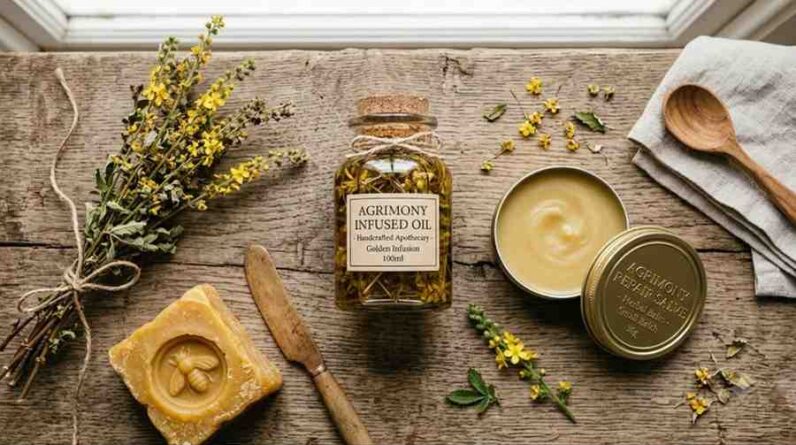
Agrimony’s tannin content is doing most of the work here. Dried agrimony contains a meaningful share of condensed tannins, and it’s this fraction that tones tissue and helps create a protective barrier over the wound bed, under which repair can happen more efficiently. Lab studies have also documented bactericidal action against Staphylococcus aureus, a common cause of wound infection, adding another layer to agrimony’s healing potential and supporting its long-standing use on minor cuts and slow-healing sores. If you want something with more staying power than a diluted wash, our agrimony salve guide turns the same herb into a shelf-stable ointment for everyday scrapes.
The clearest evidence for this comes from animal research. A wound-healing literature review (Paluch et al., 2023) cites an earlier rat study in which a 10% ethanolic agrimony extract ointment shortened wound healing time to 10 to 16 days, compared with longer healing times in untreated wounds, while a 10% aqueous extract version healed wounds in about 12 days. That’s animal data using a prepared ointment, not a direct guarantee for a homemade diluted tincture, but it’s a real, citable mechanism behind a very old folk practice.
What the Research Says About Agrimony Extract
Most of the clinical and lab research on Agrimonia eupatoria extracts has specifically used concentrated preparations rather than plain tea, which makes it directly relevant to anyone making a tincture at home.
The most rigorous human trial, an 8-week, randomized, double-blind study published in the Journal of Medicinal Food, gave adults with elevated alanine transaminase levels a concentrated agrimony aqueous extract and found meaningful drops in ALT, AST, and triglycerides compared to placebo. Separately, the effects of agrimony on hepatitis B surface antigen secretion were measured in HepG2.2.15 cells, where antiviral activity was strongest when the plant material was heated in water to 60°C, useful context if you’re deciding between a hot water-based extraction and an alcohol-based one.
A broader phytochemical review has also found that agrimony extract stimulates the antioxidant enzymes superoxide dismutase, catalase, and glutathione, and early in vitro and in vivo research points to preliminary anti-cancer and anti-diabetic actions, positioning agrimony among early-stage plant treatments for diabetes and certain cancers currently being studied in the lab. These last two areas are the least developed part of agrimony’s evidence base and come mostly from lab and animal models rather than people, so they’re worth treating as a research direction rather than a reason to self-treat either condition.
Traditional Uses Beyond the Gut
Agrimony’s astringent action on the digestive tract is its best-known use, but Western herbalism has long used the herb, and its concentrated tincture form especially, for two other systems.
Urinary tract support. Herbalists have traditionally used agrimony for urinary tract issues and kidney-related complaints, citing its mild diuretic action and its toning effect on the mucous membranes lining the urinary tract. This is traditional, practitioner-level use rather than a clinically studied indication, so it’s best approached as a supportive, gentle remedy rather than a treatment for a diagnosed urinary condition.
Nervine use. Less commonly discussed, agrimony is also classed by some herbalists as a mild nervine, meaning it’s traditionally used to ease physical tension linked to nervous system overstimulation, often blended with more familiar relaxants like lavender or skullcap. It’s also been used traditionally to help with inflammation of the gallbladder, alongside its digestive applications, though this too sits closer to folk use than settled research.
Safety Notes
- Alcohol content. A tincture is far more concentrated than tea, and it contains real alcohol. It isn’t appropriate for children, anyone avoiding alcohol, or during pregnancy or breastfeeding.
- Constipation. Agrimony’s astringent tannins can worsen constipation in people already prone to it.
- Medication timing and interactions. Tannins can bind to certain compounds in the gut. Anyone on blood-thinning or blood-sugar medication should check with a doctor or pharmacist first; lab research has found agrimony extract can inhibit clot formation via the intrinsic clotting pathway, alongside its documented effects on glucose absorption.
- Rosaceae allergy. Patch-test any topical use if you’re sensitive to roses, apples, strawberries, or almonds, since agrimony belongs to the same rose family.
- Not a diagnosis substitute. Elevated liver enzymes, a wound that isn’t healing, or persistent urinary symptoms all warrant a medical evaluation first.
Storing Your Tincture
Store finished agrimony tincture in a dark glass dropper bottle, away from heat and direct light. Properly made and stored, it holds its potency for 3 to 5 years, though labeling each batch with the date makes it easy to rotate older tinctures out first.
Frequently Asked Questions
Fill a jar about a third full with dried agrimony herb, cover with high-proof alcohol at roughly a 1:5 herb-to-alcohol ratio, seal, and macerate for 4 to 6 weeks in a cool, dark place before straining and bottling.
An 80 to 100 proof (40 to 50% ABV) vodka works well for most home tinctures, since it’s strong enough to extract tannins and flavonoids without an overpowering taste.
A standard dose is 5 to 10 ml, diluted in water, up to three times a day. Start at the lower end, especially with a homemade batch.
Yes. Diluted 1 part tincture to 3 to 4 parts cooled water, it can be applied as a wash to minor cuts and irritated skin up to three times daily.
Stored in a dark glass bottle away from heat and light, a properly made tincture typically stays potent for 3 to 5 years.
Conclusion
An agrimony tincture takes a few minutes of hands-on work and about a month of patience, and the payoff is a shelf-stable extract you can use far longer than fresh dried herb. Start with the standard 1:5 ratio, label your jar, and let time do the rest. If tea is more your speed for everyday use, our how-to guide for agrimony tea covers that method, and our full Agrimonia Eupatoria guide has the complete safety and research picture behind both.
Disclaimer: This article is for educational purposes only and is not intended as medical advice. Always consult a qualified healthcare professional before using medicinal herbs, especially if you are pregnant, nursing, taking medications, or have a medical condition. Read our full Medical Disclaimer.
References
-
- Cho, Y.M., et al. “Agrimonia eupatoria L. (Agrimony) Extract Alters Liver Health in Subjects with Elevated Alanine Transaminase Levels.” Journal of Medicinal Food, 2018 → PubMed
- Huzio, N., et al. “Phytochemical and Pharmacological Research in Agrimonia eupatoria L. Herb Extract.” Plants (MDPI), 2022 → MDPI
- Paluch, Z., et al. “Agrimonia eupatoria L. and Wound Healing.” ScienceDirect, 2023 (citing Ghaima, 2013) → ScienceDirect
- Herbal Reality. “Agrimony (Agrimonia eupatoria): Benefits, Uses, Safety.” → herbalreality.com

Written by cskoch, who researches medicinal plants and herbal wellness at Herbal Daily Care. This guide is research-based: we reviewed published trials, meta-analyses, and the manufacturer’s own sales page. We did not purchase or test the product, and we do not claim first-hand results.