

Ashwagandha is a popular herb right now. It shows up in half the supplement aisles in the country, usually next to a bold claim about stress relief or testosterone. Some of that hype holds up. Other parts don’t. Understanding real ashwagandha benefits and side effects means looking past the marketing and at the actual clinical trials. This guide walks through the efficacy and safety of ashwagandha, covering real benefits and side effects backed by actual clinical trials, not marketing copy. You’ll learn what the research supports, how to take an ashwagandha supplement if you decide to try one, and the risks that most product pages leave out. It’s written for anyone who wants a clear answer before buying a bottle, not after.
Quick Answer: Ashwagandha Benefits and Side Effects
Ashwagandha is an herbal remedy, an evergreen shrub used in Ayurvedic medicine as an adaptogen. Research suggests that ashwagandha may reduce stress and cortisol, improve sleep quality, and increase testosterone levels in men. Common side effects are mild, like upset stomach or drowsiness. Rare cases of liver injury and thyroid changes, including hypothyroidism and thyrotoxicosis, have also been reported. Talk to a doctor before daily use.
Key facts about ashwagandha:
- Ashwagandha is also called Indian ginseng and winter cherry, though it isn’t a true ginseng.
- Most clinical trials use 300 to 600 mg of root extract per day, for 6 to 12 weeks.
- A 2026 systematic review of 23 trials found it lowered cortisol and raised testosterone in men, but not in women.
- Rare liver injury cases have resolved once people stopped taking it.
- It may raise thyroid hormone levels, which matters if you have a thyroid condition.
What Is Ashwagandha, Exactly?
Ashwagandha (Withania somnifera) is an evergreen shrub grown in parts of Asia, Africa, and southern Europe, and its dried root is sold worldwide as a dietary supplement. Its Sanskrit name comes from “ashwa,” meaning horse, and “gandha,” meaning smell, because the fresh root has a strong, earthy scent. You’ll also see it called Indian ginseng or winter cherry, though it isn’t part of the true ginseng family at all.
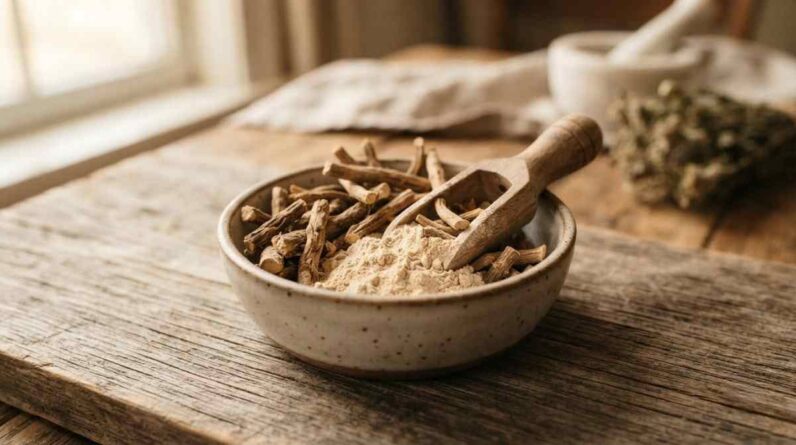
The root is the part most often used in ashwagandha supplements. Traditional Ayurvedic medicine has used ashwagandha root for centuries. It was mainly used as a general tonic for vitality and as an adaptogen: a plant substance thought to help the body handle stress. The plant’s active compounds are called withanolides, and they’re thought to give ashwagandha its adaptogenic properties. Researchers believe these compounds drive most of ashwagandha’s effects on the nervous system and hormone levels.
Ayurvedic texts describe ashwagandha as a “rasayana,” a class of herbs meant to support long-term health and resilience rather than treat one specific illness. That traditional framing lines up loosely with how modern researchers study adaptogens today, though the two traditions use very different language to describe similar ideas. Ashwagandha has been part of Ayurvedic practice for roughly 3,000 years, historically used to support vitality in older adults, aid recovery after illness, and calm the nervous system during periods of stress.
Modern ashwagandha supplements often use one of a small number of standardized, patented extracts, rather than raw root powder. KSM-66 and Sensoril are two of the most common names you’ll see on labels, and each is standardized to a specific withanolide range. This matters because most clinical trials tested one of these named extracts specifically, not generic “ashwagandha” as a category. A product using an unnamed, non-standardized extract hasn’t necessarily been tested in the same way the research you’re reading about actually used.
Modern ashwagandha supplements come in a few basic forms. Root powder is the most traditional. Standardized root extract is more concentrated and more common in capsules today, since it lets manufacturers guarantee a specific withanolide content. You’ll also find ashwagandha in gummies, tinctures, and blended “stress support” powders alongside other herbs. If you’re new to herbs in general and want a gentler starting point, our guide to herbs safe for everyday use covers more familiar options first.
Benefits of Ashwagandha: What the Research Actually Shows
Here’s the part most product pages skim past. Ashwagandha has more human research behind it than most herbal supplements. That doesn’t mean every claim holds up equally well, though. Here’s what the studies of ashwagandha actually support, sorted by how strong that evidence is.
Stress and Anxiety Support
This is ashwagandha’s best-documented use. A randomized, placebo-controlled trial published in the Indian Journal of Psychological Medicine gave adults a high-concentration ashwagandha root extract for 60 days. The study found it safely and effectively improved participants’ resistance to stress. Serum cortisol dropped in the ashwagandha group, and self-assessed stress questionnaire scores improved by a wide margin compared with placebo.
A task force from the World Federation of Societies of Biological Psychiatry has given ashwagandha root extract a provisional recommendation for generalized anxiety disorder. The group notes more data is still needed before that recommendation can get stronger, so this isn’t a settled conclusion yet.
A larger 2026 systematic review and meta-analysis in Planta Medica pooled 23 randomized trials and over 1,700 participants. It found that ashwagandha significantly reduced cortisol levels compared with placebo. Cortisol is the body’s main stress hormone, and chronically high levels have been linked to poor sleep, weight gain, and a weakened immune system. The same review found a significant increase in serotonin, a neurotransmitter tied to mood regulation.
Sleep Quality
Several smaller trials suggest ashwagandha extract can help people fall asleep faster and sleep more soundly. This seems to help most in people who already struggle with occasional sleeplessness. The effect looks tied to lower stress and cortisol, rather than direct sedation. That’s a meaningfully different mechanism than a sleep aid like melatonin. For a broader look at herbs used specifically for rest, see our guide to the best herbs for sleep.
Because cortisol and appetite are closely linked, some people use ashwagandha as part of a stress-management routine that also may support weight maintenance, especially after a period of dieting.
Testosterone and Hormone Levels
This is where the research gets specific, and where marketing tends to overstate things. The 2026 Planta Medica meta-analysis found that ashwagandha increased testosterone in men by a meaningful margin, roughly 57 ng/dL more than placebo. It found no significant testosterone increase in women, with a clear gender difference between the two results. The same review found no effect on thyroid-stimulating hormone or T3, but a modest increase in T4, a thyroid hormone. That’s worth knowing if you already manage a thyroid condition.
Smaller trials point to a similar pattern in men. A 90-day study of infertile men taking ashwagandha root extract found meaningful increases in testosterone, alongside real improvements in sperm count and motility. Researchers suspect the testosterone increase is at least partly downstream of ashwagandha’s effect on cortisol, since chronically elevated cortisol is known to suppress the body’s sex hormone production.
Exercise Performance and Muscle Strength
A systematic review and meta-analysis covering 12 studies and over 600 healthy adults, some with training experience and some without, looked at ashwagandha’s effect on physical performance. Several of those studies found improvements in grip strength, leg and arm strength, and recovery markers after resistance training, alongside the testosterone increases already discussed. Some trial designs paired daily ashwagandha with a structured 8-week resistance training program. Researchers compared this against a group doing the same training without the supplement. The ashwagandha group showed greater strength gains and less exercise-induced muscle damage over that period. This is a newer area of ashwagandha research. Results vary more by study than the stress and anxiety data do. Treat it as a reasonable supporting habit for training, not a guaranteed strength boost on its own.
Immune and Antioxidant Support
Ashwagandha’s withanolides have shown antioxidant and mild immune-modulating effects in clinical research. That means they may help support the immune system’s normal function, rather than aggressively stimulating it. Some trials report improvements in markers of both innate and adaptive immunity in healthy adults, though the effect sizes are generally modest.
Blood Sugar Support
Ashwagandha may also have a mild effect on blood sugar. A systematic review and meta-analysis published in Phytotherapy Research looked at ashwagandha’s effect on diabetes markers and found modest but fairly consistent reductions in fasting blood glucose across the trials it reviewed. Researchers believe the effect involves improved insulin sensitivity and better glucose uptake into muscle cells, partly tied to the same withanolide compounds behind ashwagandha’s other effects.
This benefit comes with a real caution attached. If you already take insulin or an oral diabetes medication, adding ashwagandha could push your blood sugar down further than expected, raising your risk of hypoglycemia. This is one more reason to loop in your doctor before combining ashwagandha with any diabetes treatment plan.
Cognitive Function and Other Possible Benefits
A handful of smaller trials suggest ashwagandha may support memory, attention, and reaction time. This shows up most in adults dealing with chronic stress that’s already affecting their cognitive performance. Research here is more preliminary than the stress and hormone data, so treat any cognitive claims as promising rather than settled.
How to Take Ashwagandha
If you decide to try an ashwagandha supplement, dose and consistency matter more than the specific brand you pick.
- Check the extract type and dose. Most clinical trials that showed benefits used 300 to 600 mg of a standardized root extract per day, usually taken once a day or split into two smaller doses.
- Give it time. Nearly every trial with meaningful results ran for at least 6 to 8 weeks before measuring outcomes. A few days of use isn’t a fair test of whether it works.
- Pick a form that fits your routine. Capsules give you a measurable, consistent dose. Powder mixed into a smoothie or warm milk is the more traditional route, but flavor and potency vary more from batch to batch.
- Take it with food if it upsets your stomach. This is a simple fix for the most common mild side effect.
- Time it around your goal. Some people take it in the morning for stress support through the day. Others prefer it in the evening, closer to bedtime, if sleep is the main goal.
- Reassess after 8 to 12 weeks. If you notice no change in stress, sleep, or energy by then, it may not be the right supplement for you.
Choosing a Quality Ashwagandha Supplement
Herbal supplements are not regulated the same way medications are. That means the label on an ashwagandha supplement doesn’t guarantee what’s actually inside the bottle. The Food and Drug Administration doesn’t review these products for effectiveness before they reach a shelf. Manufacturers are responsible for their own quality claims.
Look for a supplement that states its withanolide percentage clearly. Most successful clinical trials used extracts standardized somewhere between 1.5% and 8% withanolides (prices vary — check current price). Third-party testing seals, like NSF or USP, add a layer of outside verification that the label matches what’s in the capsule. If a product blends ashwagandha with several other unnamed “proprietary” ingredients, it’s harder to know how much of anything you’re actually getting, or whether that exact combination has been tested at all.
It’s also worth checking whether the label names a specific studied extract, like KSM-66 or Sensoril, rather than just listing “ashwagandha root extract” with no further detail. A named, standardized extract at least tells you the product is trying to match what researchers actually tested, even though it still won’t guarantee identical results in your own body.
Ashwagandha preparations vary quite a bit between brands, even at the same listed dose. That’s part of why researching specific brands and products matters more with herbal supplements than with something like a standard vitamin.
Ashwagandha Side Effects: What to Actually Watch For
Ashwagandha is generally well tolerated in clinical trials lasting up to about three months. But “generally safe” isn’t the same as “risk-free.” This is the section most wellness content underplays.
Common, Mild Side Effects
Common adverse effects of ashwagandha are mostly digestive. Upset stomach, diarrhea, and mild nausea show up most often, especially at higher doses. Drowsiness is also common. That’s worth noting if you’re taking it during the day rather than in the evening. These effects and safety concerns are typically mild, and they tend to fade with continued use or a lower dose.
Liver Injury: Rare, but Real
This is the serious side effect most product pages skip entirely. Ashwagandha’s popularity has surged in recent years, and case reports have described rare instances of clinically apparent liver injury in people taking commercial ashwagandha products. According to a review published in the National Institutes of Health’s LiverTox database, the injury typically appeared 2 to 12 weeks after starting the supplement. Jaundice and itching were the main symptoms. In most cases, discontinuing ashwagandha resolved the symptoms within one to three months, without lasting damage.
One case report described a 20-year-old man who developed jaundice, nausea, and dark urine after starting ashwagandha on his psychiatric provider’s recommendation. His symptoms resolved fully after he stopped taking it. A safety advisory from Australia’s Therapeutic Goods Administration noted a similar pattern in reported cases there, with most resolving after the product was stopped, though a small number required hospitalization.
One case series reviewed by researchers found that the doses involved in reported liver injury cases ranged from about 450 to 1,350 mg per day. That spans both typical and higher-than-typical amounts. That range doesn’t point to one obvious dosing threshold that’s clearly unsafe, which is part of why researchers still consider this an unpredictable, individual reaction rather than a simple dose effect.
Researchers still aren’t fully certain whether the injury comes from ashwagandha itself or from contamination in some commercial products, since herbal supplements can sometimes be mislabeled. Either way, it’s a real, documented risk, even though it’s uncommon. If you notice yellowing skin or eyes, dark urine, or ongoing itching while you take ashwagandha, stop and see a doctor.
Thyroid Effects
Ashwagandha may raise thyroid hormone levels. This shows up in both case reports and the modest T4 increase found in the 2026 meta-analysis discussed above. For most healthy adults, this isn’t dangerous. But if you have hyperthyroidism, Hashimoto’s disease, thyroid nodules, or you take thyroid medication like levothyroxine, this is a genuine reason to talk to your doctor first. Raising an already-elevated thyroid hormone level further isn’t a small thing to overlook.
Who Should Avoid Ashwagandha, and Drug Interactions to Know
A few groups should be more cautious with ashwagandha, or avoid it outright.
- Pregnant or breastfeeding people should avoid ashwagandha. Safety data here is too limited to recommend use.
- People with autoimmune conditions should be cautious, since ashwagandha’s immune-modulating effects could theoretically interact with conditions like rheumatoid arthritis or lupus.
- Anyone with hyperthyroidism or thyroid nodules should talk to a doctor first, given ashwagandha’s effect on thyroid hormone levels.
- Anyone scheduled for surgery should mention it to their surgical team, since ashwagandha may affect blood sugar and blood pressure. Some clinicians recommend stopping it at least two weeks before a procedure.
- Anyone with a history of liver disease should be extra cautious, given the rare hepatotoxicity case reports covered above.
Ashwagandha may also interact with several common medication categories. It can add to the drowsiness caused by sedatives, including benzodiazepines and sleep medications, which is worth knowing if you take one of those in the evening. It may affect thyroid medication dosing, as covered above, since it can shift thyroid hormone levels on its own. It may interact with immunosuppressants, given its immune-modulating effects, and with diabetes or blood pressure medications, since it can independently affect blood glucose and high blood pressure. If you take any prescription medication or manage a chronic condition, checking with your primary care physician first genuinely matters here. It isn’t just a formality, and a quick conversation is a lot cheaper than an unexpected interaction.
Ashwagandha and Women’s Health
Most of the testosterone-related headlines about ashwagandha come from studies in men, and that distinction matters. The 2026 Planta Medica meta-analysis found a clear gender difference: a meaningful testosterone increase in men, but no significant change in women. That doesn’t mean ashwagandha has nothing to offer women. The stress, cortisol, sleep, and immune research generally included both sexes and showed similar patterns across genders. It simply means the hormone-specific claims aimed at men don’t carry over to women the same way. Any marketing that implies otherwise is going beyond what the current research actually supports.
Ashwagandha vs. Other Adaptogens: What’s the Difference?
Ashwagandha is better than rhodiola for someone specifically targeting sleep and evening stress. That’s because ashwagandha’s research leans more toward calming effects, while rhodiola’s traditional use and research lean more toward daytime energy and fatigue. Asian ginseng sits somewhere in between, with more evidence for general fatigue and immune support than for either sleep or stress specifically.
None of these herbs are interchangeable, and none work identically. If sleep and evening anxiety are your main concern, ashwagandha has the deepest evidence base of the three. If daytime fatigue is the bigger issue, rhodiola or ginseng may be a better starting point.
| Herb | Best For | Typical Dose | Time to Notice Effects |
|---|---|---|---|
| Ashwagandha | Stress, sleep, testosterone in men | 300–600 mg extract/day | 6–8 weeks |
| Rhodiola | Daytime energy, fatigue | 200–400 mg extract/day | 1–4 weeks |
| Asian ginseng | General fatigue, immune support | Varies by preparation | 4–12 weeks |
Frequently Asked Questions
Research suggests ashwagandha may reduce stress and cortisol, improve sleep quality, and increase testosterone levels in men. Evidence for exercise performance, immune support, and cognitive benefits is more preliminary, but still promising.
The most common side effects are mild digestive upset, diarrhea, and drowsiness, especially at higher doses. These typically improve with a lower dose or by taking it with food.
Rare cases of liver injury have been reported in people taking commercial ashwagandha products, usually appearing 2 to 12 weeks after starting. Most cases resolved after stopping the supplement, without lasting damage, but it’s a real risk worth watching for.
Ashwagandha may raise thyroid hormone levels, so people with hyperthyroidism, Hashimoto’s disease, or those taking thyroid medication should talk to a doctor before use.
Most successful clinical trials used 300 to 600 mg of standardized root extract daily, for at least 6 to 8 weeks before measuring results. A single dose or a few days of use isn’t a fair test of whether it works for you.
Not entirely. Studies show a clear testosterone increase in men but not in women, though the stress, sleep, and immune benefits appear to apply to both sexes.
Yes. Research suggests ashwagandha may modestly lower blood sugar by improving insulin sensitivity. This is generally a benefit, but it means people on diabetes medication should monitor their glucose closely and talk to a doctor before combining the two.
Most clinical trials only tested ashwagandha for up to about three months, so long-term safety data beyond that window is limited. Many people do use it for longer periods without issue. Still, it’s worth checking in with a doctor periodically. Don’t assume indefinite daily use carries the same low risk shown in short trials.
Real-World Expectations
It helps to go in with realistic expectations. Ashwagandha isn’t a fast-acting stimulant and won’t produce a dramatic, same-day effect the way caffeine does. Most people who notice a real difference describe it as a gradual shift. They feel somewhat steadier under stress. They sleep a little more soundly, or recover a bit faster from workouts. It’s rarely a sudden transformation. If you’re looking for that kind of immediate change, ashwagandha probably isn’t the right tool. If you’re looking for a supporting habit layered on top of good sleep, reasonable stress management, and regular movement, the research gives it a genuinely reasonable case.
The Bottom Line
Ashwagandha has more real clinical research behind it, and more potential benefits studied in trials, than most herbal supplements on the market. The evidence for stress relief, better sleep, and increased testosterone in men holds up reasonably well across multiple trials. The side effects are usually mild, but the rare liver injury and thyroid effects are genuine risks that deserve more attention than most product pages give them. Research specific brands and products before buying, watch for warning signs, and loop in your doctor if you take other medications or manage a chronic condition. If you’re still exploring which herbs might fit your routine, our guide to medicinal herbs for beginners is a good next stop.
Disclaimer: This article is for educational purposes only and is not intended as medical advice. Always consult a qualified healthcare professional before using medicinal herbs, especially if you are pregnant, nursing, taking medications, or have a medical condition. Read our full Medical Disclaimer.
References
-
- National Institutes of Health, Office of Dietary Supplements. “Ashwagandha: Is It Helpful for Stress, Anxiety, or Sleep? Fact Sheet for Consumers.” → https://ods.od.nih.gov/factsheets/Ashwagandha-Consumer/
- National Institutes of Health, Office of Dietary Supplements. “Ashwagandha: Is It Helpful for Stress, Anxiety, or Sleep? Fact Sheet for Health Professionals.” → https://ods.od.nih.gov/factsheets/Ashwagandha-HealthProfessional/
- Chandrasekhar K, Kapoor J, Anishetty S. “A Prospective, Randomized Double-Blind, Placebo-Controlled Study of Safety and Efficacy of a High-Concentration Full-Spectrum Extract of Ashwagandha Root in Reducing Stress and Anxiety in Adults.” Indian Journal of Psychological Medicine, 2012. → https://pmc.ncbi.nlm.nih.gov/articles/PMC3573577
- National Institutes of Health, LiverTox Database (NBK548536). “Ashwagandha.” → https://ncbi.nlm.nih.gov/books/NBK548536/
- “Hormonal Modulation with Withania somnifera: Systematic Review and Meta-Analysis of Randomized-controlled Trials.” Planta Medica, 2026. → https://pubmed.ncbi.nlm.nih.gov/41740946/
- Durg S, Bavage S, Shivaram SB. “Withania somnifera (Indian ginseng) in diabetes mellitus: A systematic review and meta-analysis of scientific evidence from experimental research to clinical application.” Phytotherapy Research, 2020. → https://pubmed.ncbi.nlm.nih.gov/31975514/
- Therapeutic Goods Administration (Australia). Safety advisory on Withania somnifera (Ashwagandha) and liver injury. → https://www.tga.gov.au/node/565835

Written by cskoch, who researches medicinal plants and herbal wellness at Herbal Daily Care. This guide is research-based: we reviewed published trials, meta-analyses, and the manufacturer’s own sales page. We did not purchase or test the product, and we do not claim first-hand results.