

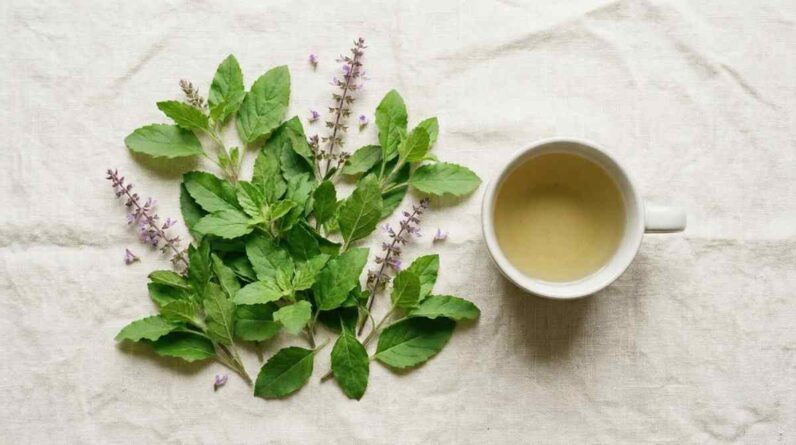
Holy Basil (Tulsi) Benefits: Uses, Evidence, Dosage & Safety
Holy basil (tulsi) is a mint-family herb used in Ayurveda for stress and general health. Small human studies suggest it may ease stress and lower blood sugar. Most of those studies were short and weak, though. Mild nausea is the main side effect. Ask a clinician first if you are pregnant or take diabetes or blood-thinning drugs.[1][3]
- What Is Holy Basil?
- How People Use Holy Basil
- Holy Basil Benefits: What the Research Shows
- How Strong Is the Evidence?
- How Much Do Studies Use?
- Side Effects and Safety
- Medicine and Health Checks
- A Careful Way to Start
- Holy Basil and Other Adaptogens
- Final Takeaway
- Frequently Asked Questions
- References
What Is Holy Basil?
Holy basil is a leafy herb in the mint family. Its science name is Ocimum tenuiflorum, and many papers also call it Ocimum sanctum.[1] In India it is known as tulsi, which people translate as “the incomparable one.”[3] Ayurvedic medicine has used it for more than 3,000 years.[1][3]
It is not the sweet basil in pasta sauce. That plant is a different species, Ocimum basilicum.[4] Holy basil tastes bitter and spicy, and some cookbooks call it hot basil.[3] Many people group it with adaptogenic herbs, which are plants thought to help the body handle stress.[3]
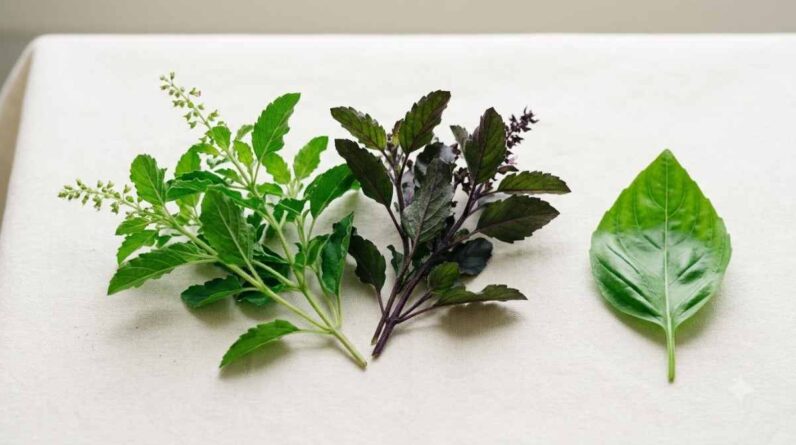
Researchers describe three main types of tulsi. Rama has green leaves and Krishna has purple ones, and both are Ocimum tenuiflorum. A wild type called Vana is a separate species.[1] Only two of the 24 human studies in a 2017 review named the type they used.[1]
How People Use Holy Basil
Tulsi has a long list of traditional uses. Old texts name it for coughs, fever, bronchitis, wounds and stomach problems.[1] Those are traditional uses, not proven treatments.
Today you can find it in a few forms:
- Tea made from dried or fresh leaves.
- Capsules or tablets of leaf powder or leaf extract.[3]
- Liquid tinctures.
- Fresh leaves that people eat or chew.
The trials used leaf powder, extract capsules, fresh leaf juice and a tincture.[1] Amounts varied a lot, so it is hard to compare one form with another.[1]
Holy Basil Benefits: What the Research Shows
People take it for stress, blood sugar, immune support and more. The main source for these benefits is a 2017 review of 24 human studies.[1] Those studies covered 1,111 people in total, and nearly all took place in India.[1]
| Area | What human studies reported | How much weight to give it |
|---|---|---|
| Stress and mood | Lower stress scores in two placebo-controlled trials. One small trial in people with an anxiety disorder had no placebo group.[1][2] | Early, but the two placebo trials point the same way. |
| Sleep | Better scores on a sleep questionnaire in one 8-week trial. A wrist tracker showed no clear gain.[2] | One trial. Very early. |
| Blood sugar | Lower fasting and after-meal glucose in several small trials of adults with type 2 diabetes.[1] | Small and short. Many had weak designs. |
| Cholesterol and blood fats | Better blood fat numbers in several small trials.[1] | Same limits as the blood sugar trials. |
| Blood pressure | Lower pressure in two tiny trials using fresh leaf juice. No change in healthy adults in another.[1] | Very thin. |
| Immune markers | Higher immune cell and signal levels in 22 healthy adults.[1] | The trial measured blood markers, not how often people got sick. |
| Thinking and focus | Better scores on some tests in 40 healthy young adults.[1] | One small trial. |
Sources: the 2017 review and the 2022 trial. The last column is our plain read of study quality, not a formal score.
Stress and mood
Stress is where the data look best. In a 2012 trial, 150 adults with stress took a whole-plant extract for 6 weeks.[1] Those on the extract had fewer stress symptoms than those on placebo, including less fatigue and fewer sleep problems.[1]
A 2022 trial in Australia gave 100 stressed adults 125 mg of extract twice a day, or a placebo, for 8 weeks.[2] Stress scores fell 37% with the extract and 19% with placebo.[2] At week 8, a lab stress test showed lower saliva cortisol, lower blood pressure and lower stress ratings in the extract group.[2] Cortisol is the body’s main stress hormone.
Read that result with care. The maker of the extract paid for the trial.[2] A separate mood checklist showed no difference between the groups.[2] And the big drop in the placebo group shows how much expectation can matter.
Anxiety is a weaker story. A 2008 trial gave 35 adults with generalized anxiety disorder 500 mg twice a day for about two months, and their scores improved.[1][2] It had no placebo group, so we can’t tell what caused the change.[2] A 4-week trial of 300 mg a day in healthy young adults found no stress difference.[1]
Sleep
Sleep has only one trial behind it. In the 2022 study, scores on a sleep problems questionnaire fell 48% with the extract and 27% with placebo.[2] A wrist tracker showed no clear difference in sleep time.[2] The authors say better sleep tests are needed.[2] For other options, see our guide to the best herbs for sleep.
Blood sugar and cholesterol
Eight of the 24 studies measured blood sugar.[1] Most were small trials in adults with type 2 diabetes. In one placebo-controlled crossover trial of 40 adults, 2.5 g of leaf powder a day for 5 weeks lowered fasting and after-meal glucose.[1] Longer trials of 12 to 13 weeks showed bigger drops than those lasting 4 to 5 weeks.[1]
In one 13-week trial, adding tulsi to the drug glibenclamide lowered HbA1c more than the drug alone.[1] HbA1c is a 3-month blood sugar average. That trial scored 1 on a 5-point quality scale, though.[1] Blood fats also improved in several small trials.[1]
Put together, this is an early signal and not a proven treatment. Merck Manuals says it may lower blood sugar but that larger, better studies are needed.[3] Blood sugar is one piece of the wider picture of metabolic health. Holy basil should never replace prescribed treatment.
Blood pressure, immunity and thinking
Two tiny trials from 1986, reported in one thesis, found lower blood pressure in people with high pressure. They used 30 mL of fresh leaf juice a day for 10 to 12 days.[1] In 22 healthy adults, 300 mg a day for 4 weeks raised some immune cell and signal levels.[1]
In 40 healthy young adults, the same 300 mg dose improved attention and working memory scores, but only after about two weeks.[1]
Claims that rest on animal or lab work
Many popular claims come from animal or test-tube studies. These include cancer fighting, radiation protection and liver protection.[1][3] Merck says none of the animal findings on seed oil has been repeated in people.[3] Animal results often do not carry over to humans.
How Strong Is the Evidence?
The honest answer is early. Only 8 of the 24 human studies had a placebo group.[1] Only three scored 4 or 5 on a 5-point quality scale, and the rest scored 0 to 3.[1] The longest study ran 13 weeks.[1]
Nearly all of the studies were done in India and printed in local journals. That makes them hard to find, and negative results may be missing.[1] Many papers also left out the plant type, the form or the exact dose.[1] The authors warn that benefits may be overestimated.[1]
The review’s authors still called tulsi safe and useful, and asked for larger and longer trials.[1] One author advises a tulsi company, though the authors say the company had no say in the paper.[1]
Merck Manuals takes a harder line. Its consumer page, fully reviewed in July 2025, says no high-quality human studies show that the herb treats any condition, and it does not recommend the herb.[3]
Both views fit the same facts. The signals are consistent and the side effects look mild. The studies are still small, short and often weak.
How Much Do Studies Use?
No official dose exists, and the 2017 review says more work is needed to settle the right dose and form.[1] What we can do is show what the trials used. We pulled these figures from the papers and added up the daily totals.
| Product type | Daily amount | Length | Who took it | Design |
|---|---|---|---|---|
| Standardized leaf extract | 250 mg (125 mg twice a day) | 8 weeks | 100 adults with stress and poor sleep[2] | Placebo-controlled, double-blind |
| Whole-plant extract | 1,200 mg (400 mg three times a day) | 6 weeks | 150 adults with stress[1] | Placebo-controlled, double-blind |
| Leaf extract capsules | 1,000 mg (500 mg twice a day) | About 2 months | 35 adults with generalized anxiety disorder[1][2] | No placebo group |
| Ethanol-based leaf extract | 300 mg once a day | 4 weeks | 22 healthy adults, and 40 in a thinking-skills trial[1] | Placebo-controlled, double-blind |
| Leaf powder | 2,500 mg | 5 weeks | 40 adults with type 2 diabetes[1] | Single-blind, placebo crossover |
| Leaf powder | 2,000 mg | 12 weeks | 90 men with type 2 diabetes or metabolic syndrome[1] | Randomized, compared with neem |
| Extract plus a diabetes drug | 300 mg plus 5 mg glibenclamide | 13 weeks | 60 adults with type 2 diabetes[1] | Randomized, drug-only comparison |
Daily totals are our arithmetic from the per-dose amounts in the papers. Extracts and powders differ in strength, so the mg numbers do not compare cleanly.
The spread is wide. The top powder dose is ten times the lowest extract dose.[1][2] The lowest amount tied to a stress benefit in a placebo trial was 250 mg a day of one standardized extract.[2] The whole-plant extract trial used nearly five times more.[1]
These trials differ in extract, in who took it and in how long. That is why a clean “right dose” does not exist yet. WebMD says adults have most often taken 500 mg a day for 1.5 to 3 months.[4] Merck judges holy basil safe for up to about 8 weeks, while the longest trial ran 13 weeks.[1][3]
The 2022 trial was paid for by the extract maker, which also supplied the capsules.[2]
Side Effects and Safety
In trials, the herb was well tolerated. Most studies reported no side effects, and one reported occasional nausea.[1] In the 2022 trial, digestive upset hit five people on the extract and five on placebo.[2] Merck lists nausea and diarrhea as the main effects.[3]
This herb is not risk-free. It might lower blood sugar, slow blood clotting and lower thyroid hormone. Animal studies also point to pregnancy risks.[3]
The table below shows each concern and where it comes from. If a row fits you, check with a doctor or pharmacist first. Never stop a prescribed medicine on your own. Our guide to herbal supplements and medication safety explains why.
Medicine and Health Checks
Each row below comes from medical references, not from large human trials. Most concerns are theoretical or based on animals.
| If this fits you | Why it matters | What the sources say |
|---|---|---|
| Insulin or sulfonylurea diabetes drugs | Blood sugar could drop too low | Merck names insulin and sulfonylureas.[3] WebMD calls it a moderate interaction and says to monitor blood sugar.[4] |
| Blood thinners such as aspirin, clopidogrel, heparin or warfarin | Bruising and bleeding could rise | Merck names these drugs.[3] |
| Planned surgery | Possible extra bleeding | WebMD says to stop at least 2 weeks before.[4] Merck says people having surgery should avoid it.[3] |
| An underactive thyroid or thyroid medicine | It might lower thyroxine | Merck says it could worsen the condition.[3] WebMD calls this concern theoretical.[4] |
| Pregnancy or trying to conceive | Large doses in animals cut the chance of a full-term pregnancy | Merck says it might not be safe and that human effects are unknown.[3] WebMD says to avoid it.[4] |
| Breastfeeding | Safety has not been studied | Merck says it is unstudied.[3] WebMD says to avoid it.[4] |
| Sedatives | Animal studies show a stronger sedative effect | Merck reports this.[3] WebMD says the data are too limited to judge.[4] |
A doctor or pharmacist can check any row against your own medicines.
A Careful Way to Start
This is general education, not a plan made for you. If you decide to try it, these steps keep things simple.
- Check the table first. If any row above fits you, ask a doctor or pharmacist before you begin.
- Pick one form. Choose tea, capsules or powder. Using one at a time makes side effects easier to spot.
- Read the label. Look for the plant name, the plant part and the amount per dose.
- Compare it with the trial table. The studies show what has been tested. They are not a target for you.
- Give it time and keep notes. Trials ran 4 to 13 weeks. Write down stomach upset, sleep changes, or blood sugar readings if you check them.
- Review after about 8 weeks. Many sources only vouch for short-term use, up to about 8 weeks.[3] Stop and call a clinician if you notice a rash, unusual bruising or signs of low blood sugar.
Holy Basil and Other Adaptogens
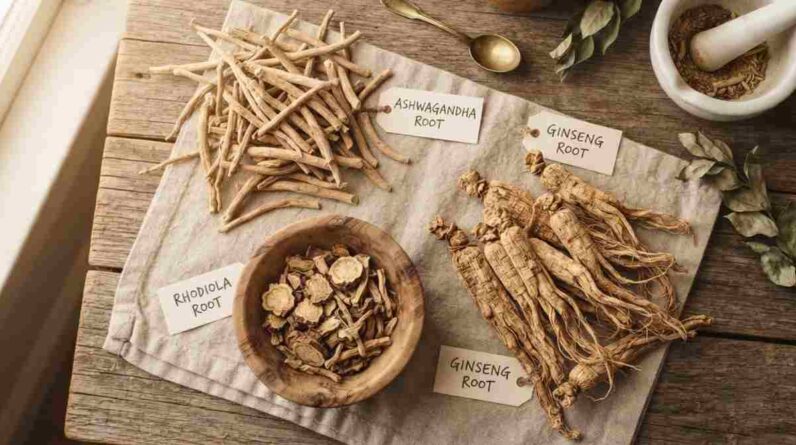
Tulsi differs from ashwagandha mainly in the plant part. It is a leaf herb, while ashwagandha and rhodiola are better known as root herbs. Merck says it is very unlikely to have such a broad range of benefits.[3]
None of these herbs has been shown to beat the others, and the trials do not compare them head to head.
The benefits look real but modest in today’s research. Early trials point to less stress and lower blood sugar. Most studies were small, short and weak. The herb seems well tolerated at the doses tested, but it is not risk-free. If you take medicine, are pregnant or plan surgery, talk with a clinician before you start.
Frequently Asked Questions
What are the main benefits of holy basil?
Small human studies suggest tulsi may lower stress and blood sugar and improve some blood fat numbers. A 2017 review of 24 human studies found mostly positive results. Most of those studies were small, short and low quality, so the benefits are not proven.
Does holy basil lower cortisol?
In a 2022 placebo-controlled trial of 100 stressed adults, those taking the extract had lower saliva cortisol after a lab stress test at week 8 than those on placebo. One company-funded trial is not enough to settle the question.
How much holy basil do studies use?
Trial amounts ran from about 250 mg to 3,000 mg a day of extract or powder, for 2 to 13 weeks. Products differ in strength, so there is no official dose. Check the label, and ask a clinician or pharmacist what fits your situation.
Is holy basil safe?
In trials lasting up to 13 weeks, it caused few problems. The most common were mild nausea or loose stools. Safety beyond a few months is not well studied. People who are pregnant, nursing, or taking diabetes or blood-thinning medicine should ask a doctor first.
Does holy basil really help with anxiety?
The evidence is thin. One 2008 trial of 35 adults with generalized anxiety disorder saw lower anxiety scores, but it had no placebo group. Stress trials look better than anxiety trials. If anxiety affects your daily life, see a healthcare provider rather than relying on an herb.
Is holy basil the same as tulsi?
Yes. Tulsi is the Hindi name for holy basil, usually Ocimum tenuiflorum. It is not the sweet basil used in pasta. Some tulsi types are separate species, so check the label for the plant name.
Tulsi is an old herb with a small but growing research base. The best-supported effects so far involve stress and blood sugar. Most trials were short and small, and many had no placebo group. Mild nausea was the main side effect. Pregnancy, nursing, diabetes drugs, blood thinners, thyroid problems and surgery are all reasons to check with a clinician first. If you try it, pick one product, keep notes, and review how you feel after a couple of months.
Disclaimer: This article is for educational purposes only and is not intended as medical advice. Always consult a qualified healthcare professional before using medicinal herbs, especially if you are pregnant, nursing, taking medications, or have a medical condition. Read our full Medical Disclaimer.
References
- Jamshidi N, Cohen MM. The Clinical Efficacy and Safety of Tulsi in Humans: A Systematic Review of the Literature. Evid Based Complement Alternat Med. 2017;2017:9217567. https://pmc.ncbi.nlm.nih.gov/articles/PMC5376420/
- Lopresti AL, Smith SJ, Metse AP, Drummond PD. A randomized, double-blind, placebo-controlled trial investigating the effects of an Ocimum tenuiflorum (Holy Basil) extract on stress, mood, and sleep in adults experiencing stress. Front Nutr. 2022;9:965130. https://www.frontiersin.org/journals/nutrition/articles/10.3389/fnut.2022.965130/full
- Merck Manual Consumer Version. Holy Basil. Shane-McWhorter L. Full review July 2025. https://www.merckmanuals.com/home/special-subjects/dietary-supplements-and-vitamins/holy-basil
- WebMD. Holy Basil: Overview, Uses, Side Effects, Precautions, Interactions, Dosing and Reviews. Licensed from Therapeutic Research Center. https://www.webmd.com/vitamins/ai/ingredientmono-1101/holy-basil
Written by cskoch, who researches medicinal plants and herbal wellness at Herbal Daily Care. This guide is research-based: we reviewed published trials, meta-analyses, and the manufacturer’s own sales page. We did not purchase or test the product, and we do not claim first-hand results.