

FIMAVYN Review: Ingredients, Doses and Safety
FIMAVYN is a two-capsule daily supplement marketed for metabolic support. It combines zinc, chromium, alpha-lipoic acid, green tea extract, berberine, resveratrol and a 112 mg herbal blend. No independent study of the finished formula turned up in our search, and several ingredient amounts are lower than those used in published trials.
Availability and pricing may change, so check the official offer for the current terms.
- What is FIMAVYN?
- What does FIMAVYN claim to do?
- FIMAVYN ingredients and doses
- Does FIMAVYN work?
- Potential benefits
- FIMAVYN side effects and safety
- How to take FIMAVYN
- Is FIMAVYN legitimate?
- Pros and cons
- FIMAVYN price and guarantee
- FIMAVYN alternatives
- Who FIMAVYN may suit
- Final verdict
- Frequently asked questions
- Conclusion
- References
What is FIMAVYN?
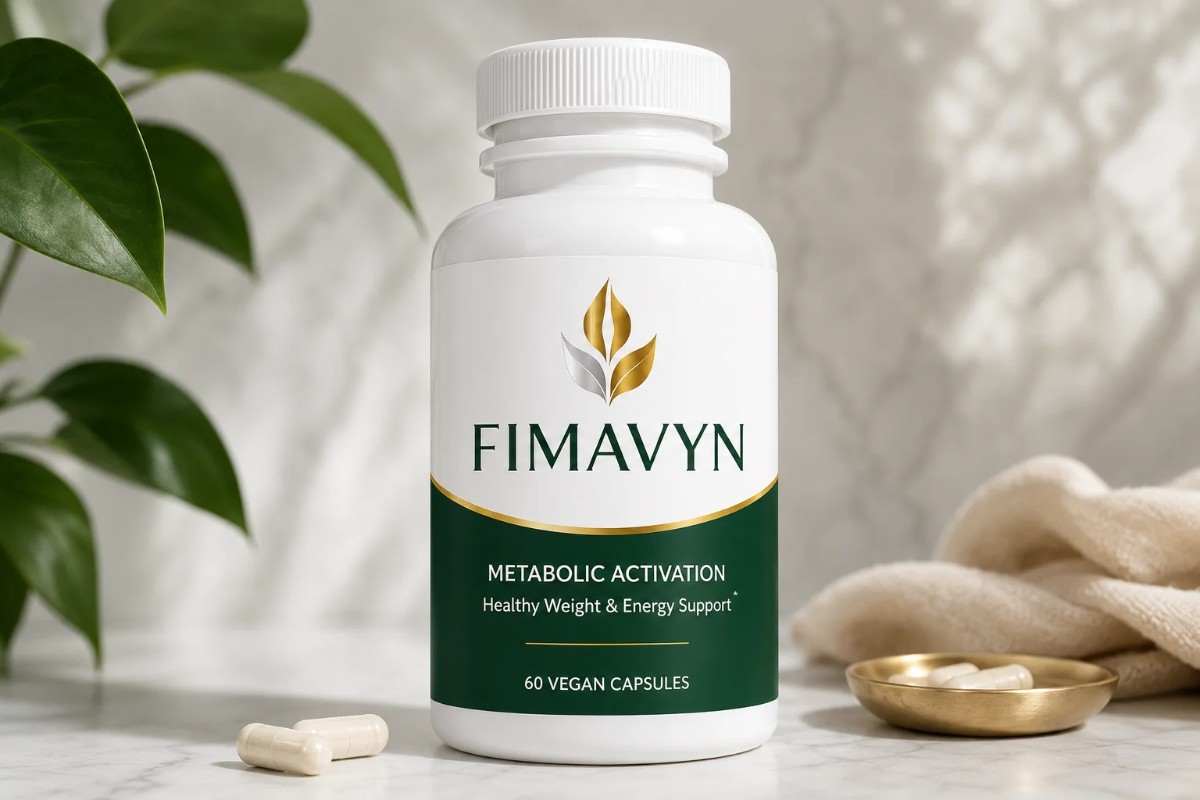
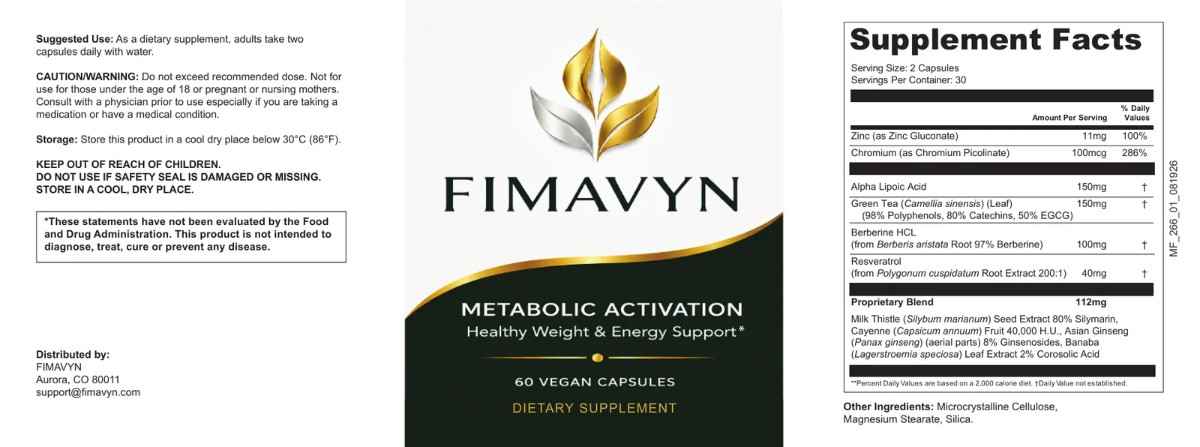
FIMAVYN is a dietary supplement sold as a bottle of 60 vegan capsules and marketed for daily metabolic support. Adults are directed on the label to take two capsules a day with water, so one bottle covers 30 servings.
Six named ingredients make up the formula: zinc, chromium, alpha-lipoic acid, green tea extract, berberine and resveratrol. A 112 mg proprietary blend adds milk thistle, cayenne, Asian ginseng and banaba leaf, and the page doesn’t break it down by amount.
One detail matters before anything else. The manufacturer’s own pages provide the product, guarantee, shipping and About information reviewed for this article. We reviewed the sales page, FAQ, guarantee, shipping and About pages in October 2026, so this article describes what was published then.
Nobody on our team has taken the product, so nothing here comes from personal use. The review rests on the manufacturer’s published pages plus independent research on each ingredient.
What does FIMAVYN claim to do?
FIMAVYN’s official pages present the product as a daily routine built around a transparent label, and they avoid most of the dramatic promises common in this category. The sales page describes it as a smarter daily approach to metabolic support and stresses that the full Supplement Facts panel is visible before purchase.
On the About page, the company says it separates facts about single ingredients from claims about the finished formula. It adds that research references are educational and not proof that any person will get a specific result. The page also says FIMAVYN doesn’t promise to diagnose, treat, cure or prevent disease, and doesn’t use fabricated testimonials, invented medical endorsements or guaranteed body-change outcomes.
That restraint is welcome, but careful wording isn’t evidence. The manufacturer states that its ingredients are researched, and independent research on the individual ingredients does exist (covered below). Research on the finished capsule is another matter: we found none.
The sales page also promotes four digital guides alongside the product, including a 30-day routine and a metabolic-friendly kitchen guide. We couldn’t read enough of the page to tell how they’re delivered, so confirm that at checkout.
FIMAVYN ingredients and how the doses compare with research
FIMAVYN’s label discloses most amounts, which makes a dose check possible. The table below sets each label amount beside the dose figures reported in the cited research, so you can see where the formula matches published work and where it doesn’t.
| Ingredient | Label amount (2 capsules) | Benchmark in research | What the research says |
|---|---|---|---|
| Berberine HCl | 100 mg | About 900 mg to 3 g a day in trials[1] | Small drops in BMI and waist size; body weight results are mixed.[2][3] The label amount is roughly 11% of the lowest benchmark. |
| Alpha-lipoic acid | 150 mg | Weight change in type 2 diabetes tracked with doses above 600 mg a day[4] | Small short-term weight loss versus placebo in one meta-analysis.[5] The label amount is 25% of the 600 mg figure. |
| Resveratrol | 40 mg | Effects on glucose and waist size above 500 mg a day[6] | Inconsistent results across trials.[7] The label amount is about 8% of the 500 mg figure. |
| Green tea extract | 150 mg | Derived safe intake of 338 mg EGCG a day for solid-form extracts[8] | The FAQ page doesn’t state EGCG content, so no comparison is possible. Liver safety is the main concern.[8][9] |
| Zinc (as gluconate) | 11 mg | Adult RDA of 11 mg (men) and 8 mg (women); upper limit of 40 mg from all sources[10] | Essential mineral. The label amount meets the male RDA and is about 28% of the upper limit. |
| Chromium (as picolinate) | 100 mcg | No established requirement | NIH describes any weight-related benefit as too small to matter for health or appearance.[11] |
| Milk thistle, cayenne, Asian ginseng, banaba leaf | 112 mg combined | Marketed milk thistle products contain 250 to 750 mg silymarin[12] | Individual amounts aren’t disclosed, so milk thistle alone can’t exceed 112 mg. Ginseng evidence on blood sugar is inconclusive.[13] |
Percentages compare label amounts with benchmark figures quoted in the cited sources, and we calculated them for this article. They compare numbers only and don’t predict results. Many benchmark doses come from trials in people with type 2 diabetes or metabolic syndrome.
Three ingredients with a clear dose benchmark (berberine, alpha-lipoic acid and resveratrol) sit between roughly 8% and 25% of the figure used in research. That gap is the main finding of this review, and it doesn’t appear on the sales page.
Berberine HCl, 100 mg
Berberine is a plant compound sold as a supplement, and it is the best-studied ingredient on the label. A 2020 meta-analysis of randomized trials found an average body weight reduction of about 2 kg, along with small drops in BMI and waist size.[2] Newer dose-response work found no significant change in body weight but did find small BMI and waist reductions.[3]
Many trials gave far more berberine than FIMAVYN contains. One review summary cites 900 mg to 3 g daily, while the label lists 100 mg.[1] The research supports berberine as an ingredient, not necessarily this amount of it.
Alpha-lipoic acid, 150 mg
Alpha-lipoic acid is an antioxidant the body makes in small amounts. A 2017 meta-analysis of ten placebo-controlled trials found about 1.27 kg more short-term weight loss than placebo, with no clear dose effect.[5] In people with type 2 diabetes, a dose-response analysis saw a linear drop in body weight at more than 600 mg a day.[4] FIMAVYN’s 150 mg is a quarter of that figure.
Green tea extract, 150 mg
Green tea extract is the one ingredient where more isn’t automatically better. A systematic review linked concentrated, catechin-rich extracts taken as solid doses to liver effects and derived a safe intake of 338 mg EGCG a day for that form.[8] Another review of randomized trials found liver-related events were few and mild.[9] FIMAVYN doesn’t state the EGCG share of its 150 mg, so we can’t place it against that figure.
Resveratrol, 40 mg
Resveratrol is a compound found in grapes and berries. One meta-analysis found no consistent change in body weight, BMI or waist size.[7] Another, in people with metabolic syndrome, found effects on glucose and waist circumference at doses above 500 mg.[6] FIMAVYN contains 40 mg.
Zinc and chromium
Zinc at 11 mg matches the adult male recommended daily amount and exceeds the 8 mg recommended for adult women, while the adult upper limit from all sources is 40 mg.[10] That leaves room unless you also take a multivitamin or zinc lozenges.
Chromium is a different story. The NIH says scientists don’t currently consider it necessary for good health, and it describes research on chromium supplements as ongoing.[11] FIMAVYN lists 100 mcg.
The 112 mg proprietary blend
The blend combines milk thistle, cayenne, Asian ginseng and banaba leaf without individual amounts. Because the total weighs 112 mg, milk thistle can’t exceed that, which is below the 250 to 750 mg silymarin range LiverTox describes for marketed products.[12] NCCIH calls ginseng research on blood sugar control overall inconclusive and conflicting.[13] We didn’t review independent evidence for cayenne or banaba, and with undisclosed amounts, none could be matched to a dose.
Does FIMAVYN work?
Nobody can say yet whether FIMAVYN works, because no published study tests the finished formula. What exists is research on individual ingredients, and that research is uneven.
The strongest signals involve berberine and alpha-lipoic acid, which have each been linked to small changes in body measurements in pooled trial data.[2][5] Much of that work enrolled people with type 2 diabetes or metabolic syndrome, so it may not carry over to otherwise healthy adults. Both ingredients also appear in FIMAVYN at amounts well under the doses behind those findings.
Combination formulas add a further problem. A mix of ten listed ingredients can’t be assumed to behave like the sum of its parts, and we found no study of this particular blend. Small amounts of many ingredients may do little, and they may interact in ways that no study has measured. Published results for FIMAVYN itself don’t exist, so any promised outcome is untested.
Potential benefits of FIMAVYN’s ingredients
The ingredients in FIMAVYN have each been studied for metabolic markers, and some trials show modest effects. Berberine has been linked to small reductions in BMI and waist circumference, and alpha-lipoic acid to small short-term weight loss compared with placebo.[2][5] Zinc is an essential mineral, so a diet short on it could be topped up by an 11 mg serving.[10]
These are group averages from trials, not predictions for one person. Effects were small, and they came from studies with different doses, durations and participants. Nobody should expect a specific result, and FIMAVYN’s own pages say they don’t promise one.
FIMAVYN side effects and safety
No safety data exists for the finished FIMAVYN formula, so the picture below comes from research on its ingredients. The main concerns are stomach upset, rare liver injury, blood sugar changes and medicine interactions.
Berberine’s most common side effects are abdominal pain, constipation, diarrhea, nausea and vomiting.[14] NCCIH says it can cause or worsen jaundice in newborns, and that people who are pregnant or breastfeeding should not use it.[14] It also interacts with some medicines, including cyclosporine.[15]
Concentrated green tea extracts have been linked to rare cases of liver injury.[8] Zinc from all sources should stay under 40 mg a day for adults.[10] Asian ginseng can interfere with blood clotting and might lower blood sugar.[13]
Blood sugar and medicine interactions
Several ingredients can lower blood sugar on their own, and nobody has studied them together in one capsule. Berberine has been studied for glucose control,[1] milk thistle might lower blood sugar in people with type 2 diabetes,[16] and Asian ginseng might do the same.[13] If you take diabetes medication, blood thinners or an immunosuppressant, ask your prescriber or pharmacist before trying FIMAVYN.
Who should avoid FIMAVYN?
The manufacturer’s warning says FIMAVYN isn’t for people under 18 or for pregnant or nursing mothers, and it advises consulting a physician first if you take medication or have a medical condition. According to the FAQ, final label wording is still subject to revision. Based on the ingredient research, these groups should also get medical advice first:
- Anyone taking cyclosporine or another immunosuppressant.[15]
- Those taking warfarin or another blood thinner.[13]
- People with diabetes who use glucose-lowering medicine.[16]
- Anyone with an existing liver condition, since green tea extract and ginseng have been linked to rare liver injury.[8][13]
How to take FIMAVYN
Adults are directed on the label to take two capsules daily with water, which is the manufacturer’s stated dosage. These steps turn that direction into a more careful routine, and they aren’t individualized medical advice.
- Check with a professional first. Ask a doctor or pharmacist, particularly if you take medication or have a medical condition.
- Read the final label. The FAQ says wording remains subject to a revised label, so compare the bottle you receive with the amounts listed here.
- Take two capsules daily with water. Don’t exceed the recommended dose, and count zinc from any other supplements.
- Watch for warning signs. Stop and contact a clinician if you notice stomach pain that won’t settle, yellowing of the skin or eyes, or dark urine.
- Note the refund window. The stated guarantee runs 60 days, so keep your order details.
Is FIMAVYN legitimate?
FIMAVYN pros and cons
- Most ingredient amounts are disclosed
- Claims are restrained, with no cure or guaranteed-result language
- Published 60-day money-back policy
- Vegan capsules and clear directions
- Free shipping on larger packages within the continental U.S.
- No published study of the finished formula
- Berberine, alpha-lipoic acid and resveratrol sit well below research doses
- A 112 mg blend hides four ingredient amounts
- New product with no customer reviews
- Many ingredients that can interact with medicines
- Company identity not named in the pages reviewed
FIMAVYN price and guarantee
FIMAVYN’s official page lists three package sizes, from $69 for one bottle to $294 for six (prices vary, so confirm current price and terms at checkout). Treat these as listed prices and confirm the current amount before ordering.
| Package | Supply | Listed price | Shipping | Cost per day |
|---|---|---|---|---|
| 1 bottle | 30 days | $69 | $9.99 standard | $2.30 ($2.63 with shipping) |
| 3 bottles | 90 days | $177 | Free, continental U.S. | $1.97 |
| 6 bottles | 180 days | $294 | Free, continental U.S. | $1.63 |
Cost per day is the listed price divided by days of supply at two capsules a day, calculated for this article. Prices come from the manufacturer’s sales page and shipping policy as displayed in October 2026.
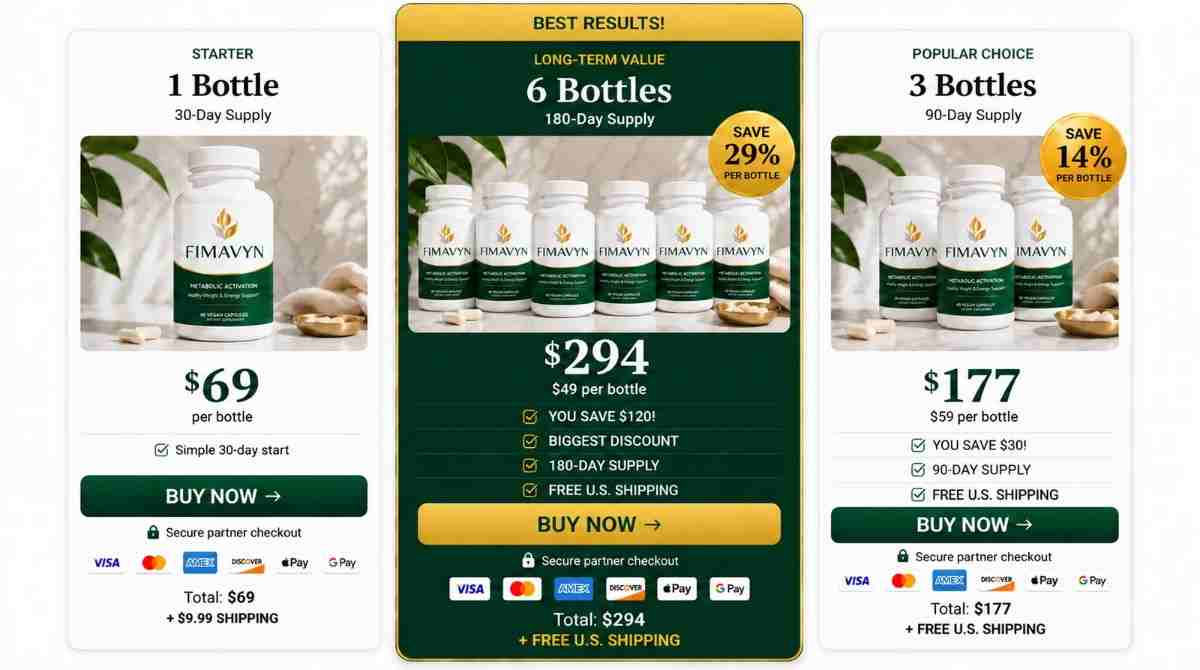
Shipping: The 1-bottle option has a $9.99 shipping charge. The 3- and 6-bottle packages include free U.S. shipping within the continental United States.
Guarantee: FIMAVYN purchases come with a minimum 60-day, no-questions-asked money-back guarantee. Review the guarantee terms before ordering.
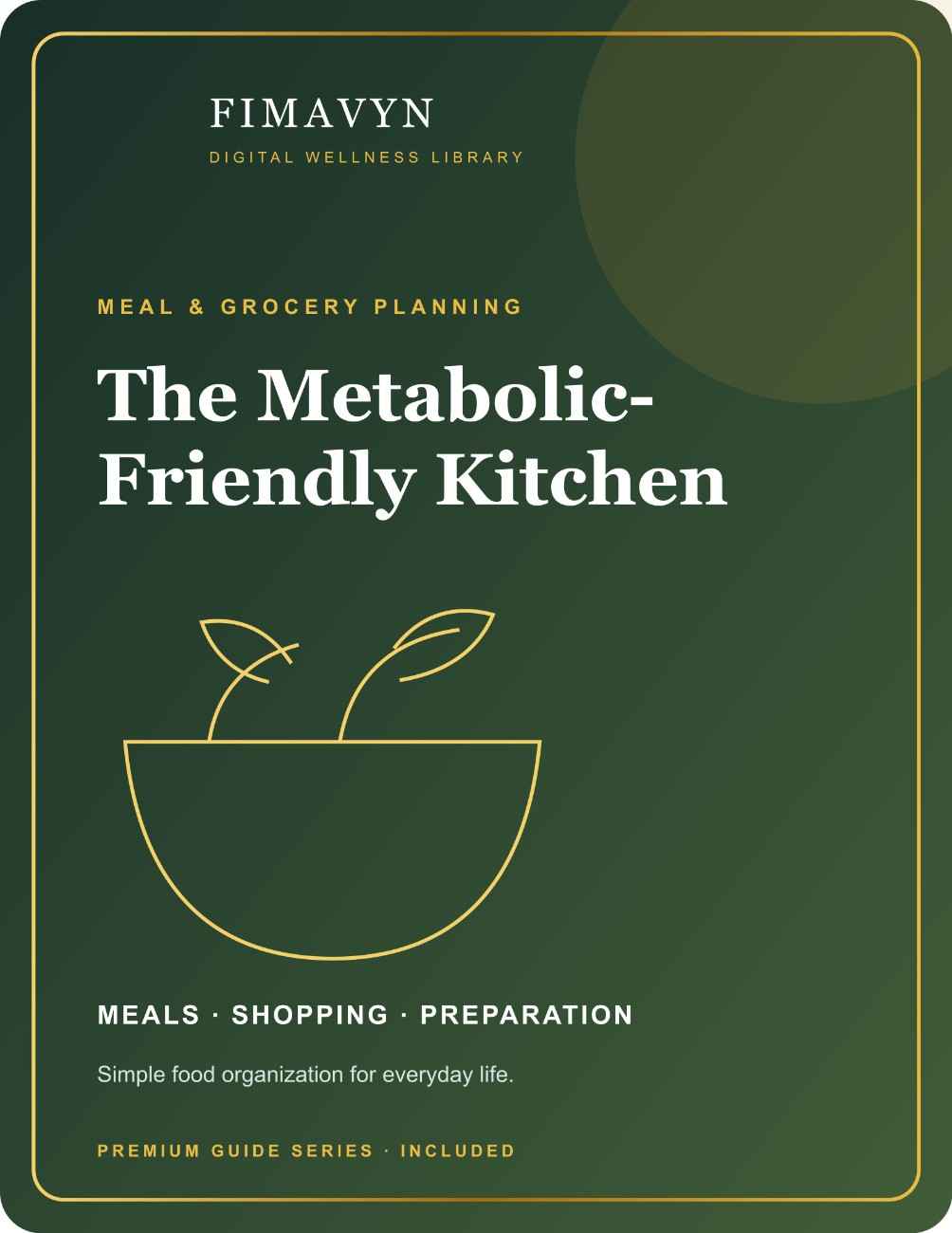
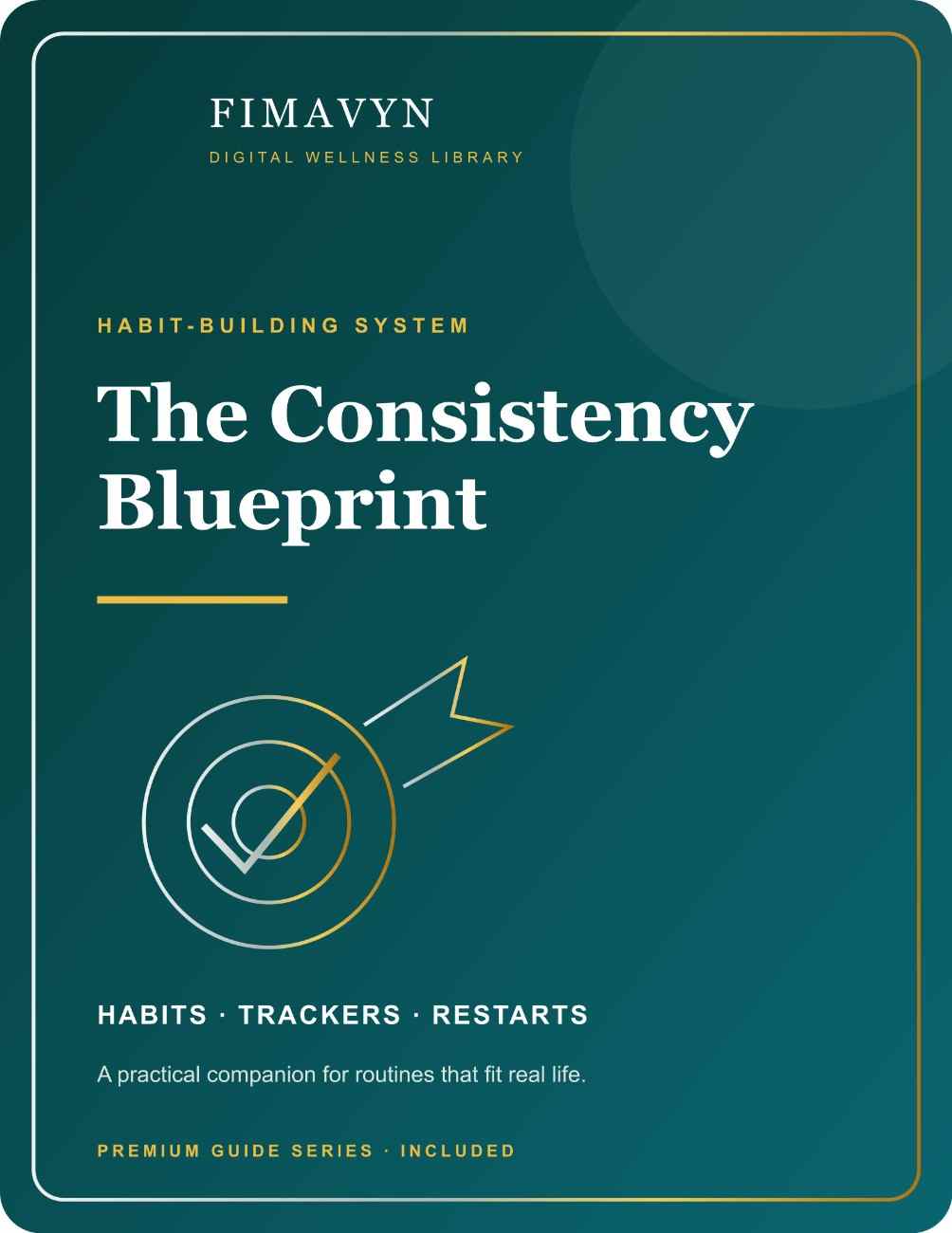
Additional materials included with the offer.
The FIMAVYN offer also includes four digital guides covering daily routines, meal planning, consistency, and morning organization. These are supplementary materials and are not evidence that the formula itself is effective.

The manufacturer’s published guarantee is a minimum 60-day, no-questions-asked money-back policy. Eligible customers can request a refund without proving the product failed by emailing support@fimavyn.com, and a physical return may need to follow the instructions on the returns page. The policy covers purchase satisfaction and doesn’t guarantee any health, weight or medical outcome.
Shipping is planned for the continental United States only at launch, with standard delivery estimated at three to five business days after about 24 hours of processing. Alaska, Hawaii, U.S. territories, military addresses and international destinations aren’t enabled in the current ordering process. Those figures are estimates, not guaranteed delivery dates.
We couldn’t confirm whether the ordering process includes upsells, order bumps or a recurring subscription. The sales page appears to include a question about subscriptions, so look for that answer before you pay. Read each screen of the order flow before submitting payment.
FIMAVYN alternatives
FIMAVYN’s alternatives fall into two groups: single-ingredient supplements and other multi-ingredient supplement formulas. A single-ingredient berberine capsule differs from FIMAVYN because it can put the whole serving into one compound, while FIMAVYN spreads small amounts across ten ingredients. That trade-off cuts both ways, since fewer ingredients mean fewer interaction questions and research doses are easier to match.
We didn’t name specific competing products, because we couldn’t verify their current labels or pricing for this review; see our XenBurn review for another supplement example. When you compare any alternative, check four things: the amount of each active, whether blends hide amounts, the cost per day, and the refund terms. If you have a diagnosed condition such as diabetes, a prescriber can also discuss options that have regulatory-reviewed evidence.
Who FIMAVYN may suit
FIMAVYN may suit healthy adults who want a daily multi-ingredient supplement, accept limited evidence, and have cleared it with a clinician. It is a weaker fit for anyone who wants research-level doses of a specific ingredient, takes medication, is pregnant or nursing, or has a liver or blood sugar condition.
Waiting also makes sense if you want customer reviews or a stable label, since neither exists yet.
Final verdict
FIMAVYN is an openly labeled formula with modest doses and no finished-product research. Its ingredients have some independent research behind them, mostly at higher amounts than the label lists.
If the transparency and the 60-day policy appeal to you, and your clinician is comfortable with the ingredients, the official offer is where to check current status and pricing. Anyone who wants proven results won’t find a promise in the evidence reviewed here.
Frequently asked questions
Is FIMAVYN legit?
FIMAVYN is a dietary supplement with a published ingredient list, a stated 60-day money-back policy, and shipping and returns pages, which are signs of basic transparency. No independent studies or customer reviews of the finished formula were found. Confirm current availability and terms before ordering.
Is FIMAVYN a scam?
The pages reviewed for this article showed no fabricated testimonials or guaranteed-result promises, and the manufacturer says it avoids both. A new product with no customer reviews still has limited customer history to judge. Read the refund terms before paying, and check your card statement afterward.
Does FIMAVYN work?
No published study tests the FIMAVYN formula itself, so its effects are unknown. Some of its ingredients, such as berberine and alpha-lipoic acid, have been linked to small changes in weight or body measurements in trials, but those trials often used larger doses than FIMAVYN’s label lists. Results vary between people.
What are the FIMAVYN side effects?
No safety data on the finished product was found, so this answer comes from research on its ingredients. Berberine can cause stomach upset, green tea extract has been linked to rare liver injury, and several ingredients may lower blood sugar or interact with medicines. The manufacturer says FIMAVYN is not for anyone under 18 or for pregnant or nursing mothers.
How much does FIMAVYN cost?
The official page lists $69 for one bottle plus $9.99 shipping, $177 for three bottles, and $294 for six bottles, with free U.S. shipping on the larger packages. A bottle holds 30 servings, so the listed prices work out to about $2.30, $1.97 and $1.63 per day before shipping. Prices vary, so confirm the current price and terms at checkout.
What is the FIMAVYN dosage?
The manufacturer’s label directs adults to take two capsules daily with water. A bottle has 60 vegan capsules, which is 30 servings. Do not exceed the recommended dosage, and ask a doctor or pharmacist first if you take medication or have a medical condition.
Does FIMAVYN have a refund policy?
The manufacturer’s published policy is a minimum 60-day money-back guarantee with no requirement to prove the product failed. Refund requests go to support@fimavyn.com, and a physical return may need to follow the instructions on the returns page. The guarantee covers purchase satisfaction, not any health or weight outcome.
Can you buy FIMAVYN yet?
Yes. FIMAVYN can be purchased through the official offer. Check the current price, availability and purchase terms before ordering.
Conclusion
FIMAVYN pairs a clear label with a formula that independent research only partly supports. Several doses sit well below those used in studies, and the finished product hasn’t been tested. Read the final label, check your medications with a professional, and confirm price and guarantee terms at checkout before deciding.
References
- Berberine: benefits, dosage, contraindications. Darwin Nutrition (summary of clinical research). https://www.darwin-nutrition.fr/?p=65929
- The effect of berberine supplementation on obesity parameters, inflammation and liver function enzymes: a systematic review and meta-analysis of randomized controlled trials. Clin Nutr ESPEN. 2020. https://pubmed.ncbi.nlm.nih.gov/32690176/
- The effect of berberine supplementation on obesity indices: a dose-response systematic review and meta-analysis. Coventry University research portal. https://pureportal.coventry.ac.uk/en/publications/the-effect-of-berberine-supplementation-on-obesity-indices-a-dose/
- Efficacy and safety of oral alpha-lipoic acid supplementation for type 2 diabetes management: a systematic review and dose-response meta-analysis of randomized trials. Endocr Connect. 2022. https://pmc.ncbi.nlm.nih.gov/articles/PMC9578061
- Alpha-lipoic acid as a supplementation for weight loss: results from a meta-analysis of randomized controlled trials. Obes Rev. 2017;18(5):594-601. https://pubmed.ncbi.nlm.nih.gov/28295905/
- Meta-analysis of resveratrol intake and metabolic parameters in metabolic syndrome patients. PubMed, PMID 31065943. https://pubmed.ncbi.nlm.nih.gov/31065943/
- Resveratrol Supplementation and its Potential Benefits in Obesity-related Non-communicable Diseases. In Vivo. https://iv.iiarjournals.org/content/40/2/748
- The safety of green tea and green tea extract consumption in adults: results of a systematic review. Regul Toxicol Pharmacol. 2018. https://pubmed.ncbi.nlm.nih.gov/29580974/
- Liver-related safety assessment of green tea extracts in humans: a systematic review of randomized controlled trials. PubMed Central. https://pmc.ncbi.nlm.nih.gov/articles/PMC5193539
- Zinc: Fact Sheet for Consumers. NIH Office of Dietary Supplements. https://ods.od.nih.gov/factsheets/Zinc-Consumer?print=1
- Chromium: Fact Sheet for Consumers. NIH Office of Dietary Supplements. https://ods.od.nih.gov/factsheets/Chromium-Consumer/?print=1
- Milk Thistle. LiverTox, NCBI Bookshelf (NIH). https://www.ncbi.nlm.nih.gov/books/NBK548817/
- Herb-Drug Interactions: What the Science Says. NCCIH (NIH). https://www.nccih.nih.gov/health/providers/digest/herb-drug-interactions-science
- In the News: Berberine. NCCIH (NIH). https://www.nccih.nih.gov/health/in-the-news-berberine?nav=tw
- Berberine and Weight Loss: What You Need To Know. NCCIH (NIH). https://www.nccih.nih.gov/health/berberine-and-weight-loss-what-you-need-to-know?nav=govd
- Milk thistle. Mayo Clinic. https://www.mayoclinic.org/drugs-supplements/milk-thistle/art-20362885

Written by cskoch, who researches medicinal plants and herbal wellness at Herbal Daily Care. This guide is research-based: we reviewed published trials, meta-analyses, and the manufacturer’s own sales page. We did not purchase or test the product, and we do not claim first-hand results.